



Other species that we help protect in Central Africa

Through education and raising awareness among local communities, as well as providing material support to forest rangers, we contribute not only to the protection of gorillas but also to the conservation of other endangered animal species that inhabit the African rainforest.
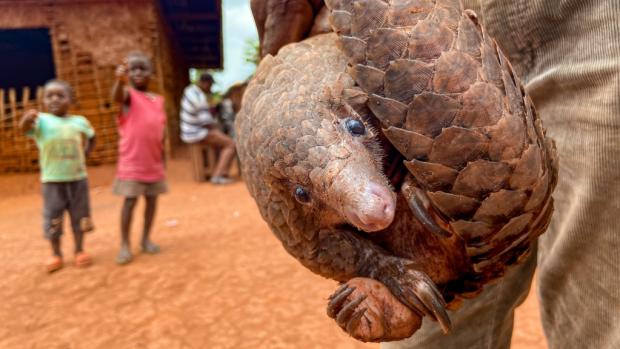 A pangolin offered for sale in Mbama, Cameroon. Photo: Miroslav Bobek, Prague Zoo
Among the most threatened species are:
Pangolins (Smutsia gigantea, Phataginus tetradactyla, P. tricuspis)
Pangolins are currently believed to be the most trafficked mammals in the world, primarily due to their scales, which are in high demand in Asia. The scales are used in so-called "traditional" medicine, and the populations of Asian pangolins are no longer able to meet the demand. As a result, attention has turned to Africa, from where pangolin scales are now exported on a large scale. A poacher receives about 1,000 Central African francs (roughly €1.50) for the scales of a long-tailed pangolin, and ten times that for a kilogram of giant pangolin scales.
In addition, pangolins are widely hunted for their meat in Cameroon. The consumption of bushmeat is not a necessity in cities; instead, it is largely driven by personal preference, with pangolin meat regarded as a delicacy. In Cameroonian urban markets, a pangolin dish costs between 500 and 2,500 Central African francs (approximately €0.75–3.80), making it affordable for all income groups. Surveys show that up to half of consumers would even be willing to pay more for it, including those on low incomes—an indication of how popular pangolin meat is. This strong demand has created unsustainable hunting pressure on wild populations, with pangolins commonly sold in markets, restaurants and street food stalls, despite being subject to the highest level of legal protection.
Market demand thus poses a serious threat to pangolins, particularly given their slow reproductive rate. They typically give birth to only a single offspring, and their generation time is around eight years. Farm breeding is completely out of the question: not only would it be economically unviable given their slow reproduction, but pangolins are also exceptionally sensitive animals with highly specialised dietary requirements and weak immune systems. As a result, it is extraordinarily difficult to keep them healthy in human care—let alone to breed them successfully.
Further reading:
Trade with Pangolins in Cameroon
The third Saturday in February: World Pangolin Day
Valentine’s week with pangolins
Pure terror in the eyes of defenceless animals
Forest Elephant (Loxodonta cyclotis)
Large mammals such as elephants and great apes play a crucial role in forest ecosystems as seed dispersers. Over 100 plant species have been identified in the dung of forest elephants. In this way, elephants contribute to forest regeneration and help maintain biodiversity. Their hunting can therefore disrupt complex ecological relationships, potentially worsening the impacts of climate change in the region.
Among farmers living near forests, elephants are often seen as pests that destroy crops. However, they are shot for many reasons, including for their meat and ivory. According to a pygmy hunter from the Dja region, every part of an elephant can be sold: skin, ears, tail, brain, even dung. Globally, the population of forest elephants has experienced a dramatic decline, with numbers dropping by more than 80 % in just three generations (approximately 93 years).
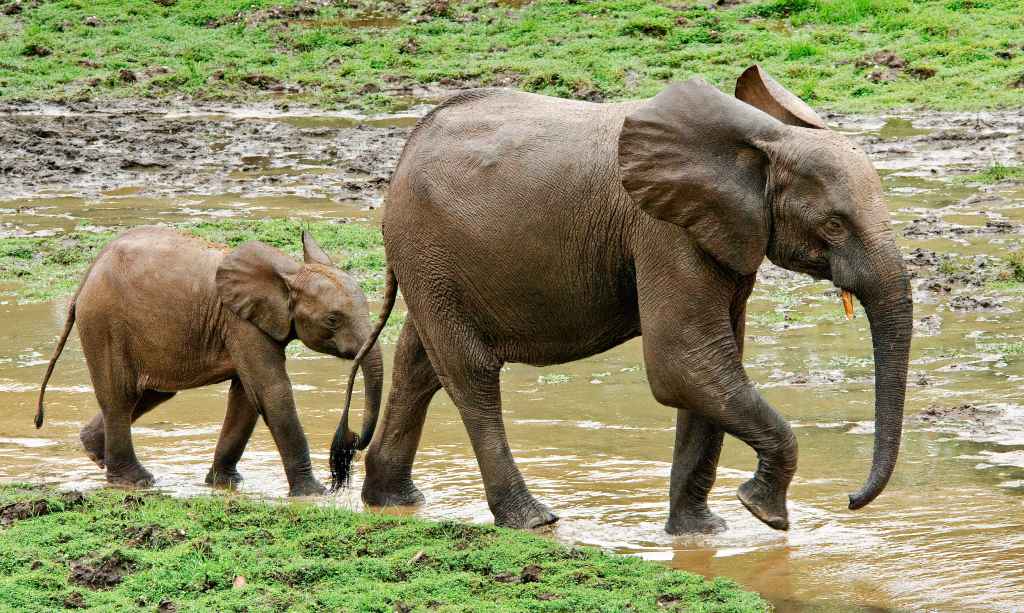
Forest elephants from the Dja reserve. Photo: Miroslav Bobek, Prague Zoo
ZOOPRAHA.CZ
Contacts
- The Prague zoological garden
U Trojskeho zamku 120/3
171 00 Praha 7
Phone.: (+420) 296 112 230 (public relations department)
e-mail: zoopraha@zoopraha.cz
Others