


Other activities of Prague Zoo in Central Africa

Our other activities in Central Africa include, in particular, supporting education and awareness through our own printed materials, providing material support to forest rangers, and assisting regional organisations focused on the conservation of primates and other wildlife, as well as on sustainable development and the search for alternative livelihoods to bushmeat hunting.
Saving the endangered species of Central Africa is not possible without a conscious and respectful approach by local communities to the tropical rainforest and the wildlife that inhabits it. The fight against poaching and the protection of nature in this region rests on three main pillars:
- legislation and its enforcement, primarily ensured by forest rangers ("ecoguards")
- education and public awareness
- the provision of alternative sources of livelihood or supplementary income
These are precisely the pillars we strive to strengthen through our projects.
Cooperation with the Dja Faunal Reserve
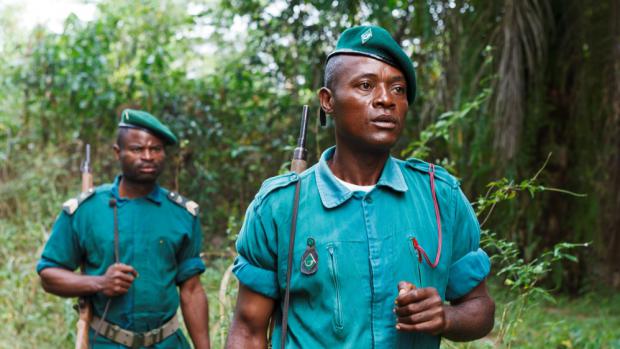
Rangers of the Dja Biosphere Reserve. Photo: Khalil Baalbaki, Prague Zoo
The most important area of Prague Zoo’s work in Central Africa is the Dja Faunal Reserve in Cameroon. That is where the Wandering Bus runs from and where material support has been flowing in to.
Prague Zoo has long supported the forest ranger units in Dja—known as ecoguards—who are on the front lines of the fight against poaching and also play a vital educational role. In the early years of Prague Zoo’s involvement in Cameroon, its support for the Dja Faunal Reserve consisted mostly of providing the rangers with bare essentials such as boots, tents, and backpacks. Over time, this support expanded. In 2021, for example, Prague Zoo funded the production and placement of 96 signs marking the boundaries of the reserve. The aim was to raise awareness among local communities about the existence of a restricted zone and, as a result, to make it easier to protect the area, which is heavily affected by poaching and illegal logging.
Prague Zoo also used its funds to purchase computers and an all-terrain vehicle, a Toyota Hilux, for the rangers, which makes it easier for them to patrol the roads and to crackdown on poachers or bushmeat traffickers. All vehicles that the zoo has ever provided abroad have always been marked with at least the logos of Prague Zoo and the City of Prague, but this Hilux is an exception. It must not attract attention or be easily identifiable, so that poachers are not warned in advance. Interventions against poachers should also not be associated with foreigners, as this could create unnecessary hostility towards the ecoguards and conservationists in general.
Educational materials for Central African children
Over the years, Prague Zoo, in cooperation with local conservationists, has distributed tens of thousands of printed materials of its own creation to schoolchildren living around the Dja Faunal Reserve in Cameroon and other Central African countries, particularly in the vicinity of protected areas where western lowland gorillas live. These included, for example, colouring books, playing cards, and postcards—all aimed at raising awareness, educating, and fostering a positive attitude among children towards gorillas and other wildlife. The most significant of these, however, were two titles: the book Gorilla Fairy Tales and, most recently, the educational booklet Little Gorilla.
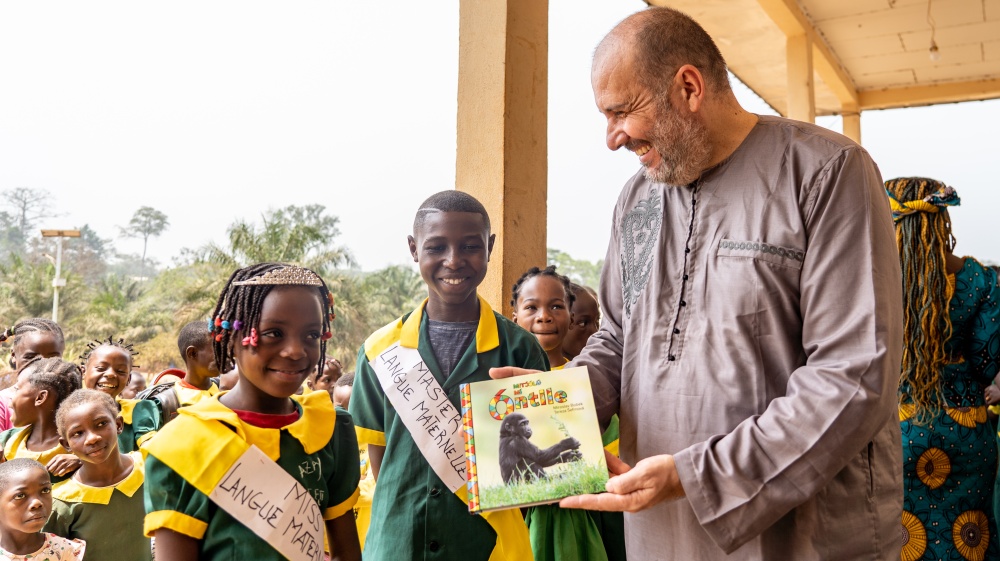
Gorilla Tales, which build a positive relationship between children and gorillas and the rainforest, have already been read by thousands of Central African schoolchildren. In 2022, the then director of Prague Zoo, Miroslav Bobek, introduced a new feature to a Cameroonian school: the publication of Gorilla Tales in the local Badjoué dialect. Photo: Oliver Le Que, Prague Zoo
Gorilla Fairy Tales, co-authored by Prague Zoo’s former director Miroslav Bobek, was not only published in French and English, but also became the very first hardback book in the Badwe’e dialect of the Koonzime language, spoken in the area surrounding the Dja Faunal Reserve in Cameroon. The book’s mission within the Congo Basin mirrors that of the Wandering Bus project: to support the education of rural children and to present gorillas as fascinating creatures worthy of protection. By publishing it in Badwe’e, Prague Zoo has taken a bold step into new territory—contributing not only to wildlife conservation but also to the preservation of one of the region’s lesser-known languages.
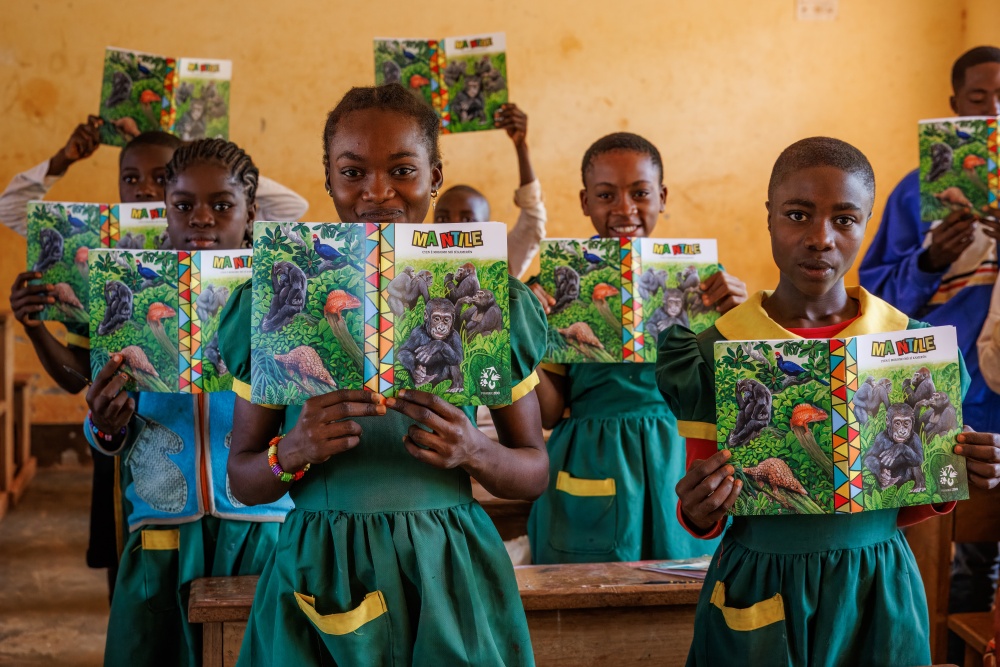
In 2025, children in the Cameroonian town of Somalomo on the edge of the Dja Faunal Reserve received an educational brochure from the Prague Zoo called Little Gorilla (here in the local Badwe’e dialect). Photo: Miroslav Bobek, Prague Zoo
The Little Gorilla booklet, written by Prague Zoo’s education specialist Václava Podhráská, serves as a tailor-made "textbook" for teaching conservation to Central African children. It was created at the request of the Dja reserve’s management, which, on the basis of the Wandering Bus project’s results, approached Prague Zoo to develop a comprehensive educational programme for the entire reserve. Thousands of copies were distributed to Cameroonian schools and partner institutions in early 2025. As with Gorilla Fairy Tales, the booklet was published not only in French but also in the Badwe’e dialect, thanks to a translation by local pastor Ekoalea, to reach a broader audience and further support the region’s cultural heritage.
Cooperation with the Mefou Primate Sanctuary
The Mefou Primate Sanctuary, located near Cameroon’s capital, Yaoundé, approximately 300 km from the Dja area, is operated by the non-governmental organisation Ape Action Africa. A visit to this sanctuary marks the highlight of the Wandering Bus journeys, as it is often the very first time the children get to see live gorillas—as well as chimpanzees and other primates. That is why we support the sanctuary’s educational programme
Support for Experimental Palm Weevil Farming
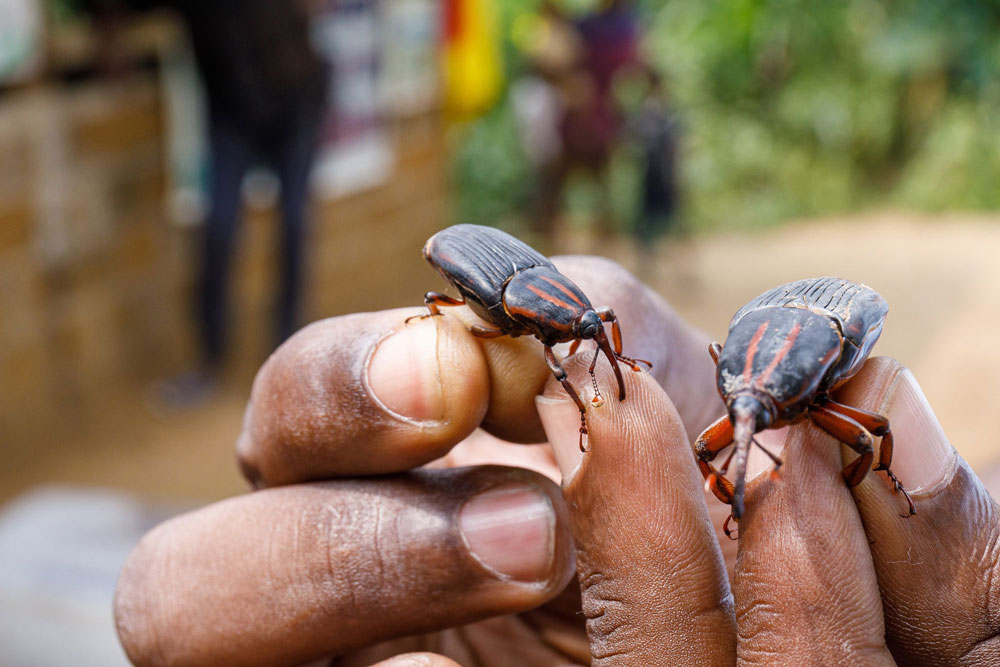
Palm weevils. Photo: Miroslav Bobek, Prague Zoo
The consumption of wild animal meat remains popular across various social classes in Cameroon and continues to serve as a source of livelihood for some communities. One potential way of fighting poaching is to offer people both an alternative income and a sustainable source of protein through the cultivation of palm weevils (Rhynchophorus phoenicis), the larvae of which are a local delicacy.
The organisation Forest Living Trust, in cooperation with entomologist Fogoh John Muafor, is working to establish weevil farms that would provide local communities with a sustainable source of income while reducing dependence on the problematic bushmeat. At the same time, farming them is significantly more environmentally friendly than harvesting them from the wild. Prague Zoo supported one of these farms in the past, and its visit has become part of the Wandering Bus route.
For further details, click here.
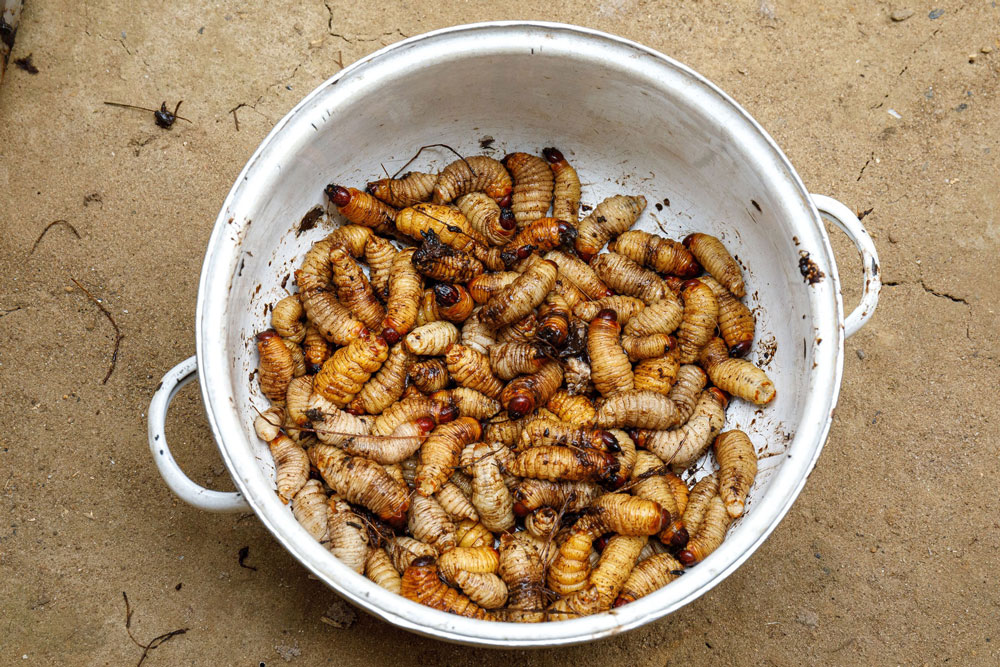
A pot with farm larvae before cooking. Photo: Miroslav Bobek, Prague Zoo
Support for the Ngoyla Reserve
In recent years, Prague Zoo has also been involved with the Ngoyla Reserve, located in the south-eastern part of Cameroon. This reserve lies on the migration corridor of animals going from the Dja region deeper into Central Africa. We have provided financial support for the environmental education, with a particular focus on the youth living near the reserve’s borders.
Support for Douala-Edéa National Park
The Douala-Edéa area, lying on Cameroon’s north-western coast at the mouth of three large rivers including Cameroon’s longest river Sanaga, is one of the country’s most valuable natural areas. The landscape, dominated by lush rainforest and mangroves, is interwoven with a vast network of lagoons and river channels, interspersed with lakes and sandy beaches. It is an area of exceptionally high biodiversity, supporting species such as forest elephants, chimpanzees, sea turtles, manatees, and an astonishing array of birds. The freshwater, estuarine and coastal forest complexes found here are among the largest and most intact in Africa.
Some of this wild landscape is formally protected as Douala-Edéa National Park. Nevertheless, nature in the Douala-Edéa area is under significant pressure. The most serious threats include unsustainable fishing practices and deforestation. Awareness of the existence of the national park and of the restrictions associated with its protected status remains limited among local communities, partly due to the park’s relatively recent establishment in 2018.
Prague Zoo has therefore decided to support Douala-Edéa National Park. In 2025, we helped finance the marking of the park’s terrestrial boundaries and the installation of information and warning signs outlining prohibitions within the protected area. These measures are intended to curb illegal activities and to facilitate more effective legal enforcement. An awareness-raising campaign targeting local communities is also planned, aiming to improve knowledge of the park’s existence and the delineation of its boundaries.
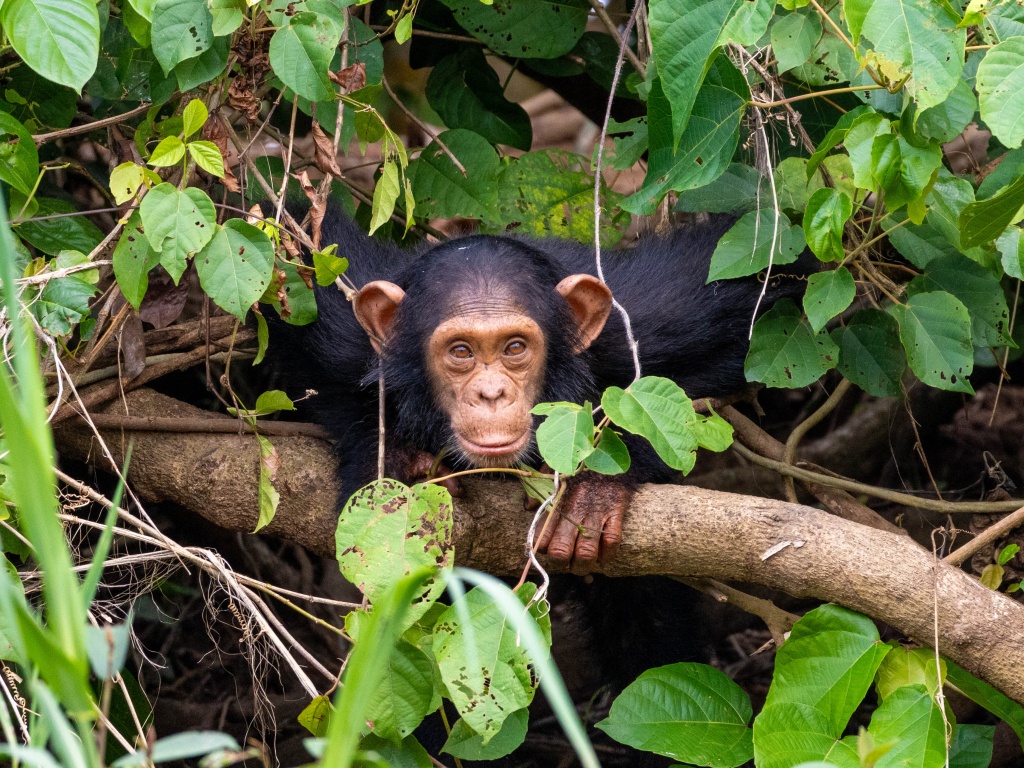
In the very heart of the Douala-Edéa National Park lies a sanctuary for orphaned chimpanzees, run by the Association Papaye International. From the rescued individuals, several free-living troops have formed over the years, which now raise their own offspring on the islands of the Sanaga River, safely away from villages and any potential conflicts. Photo: Kristýna Čechlovská, Prague Zoo
Eastern lowland gorilla protection in the DR Congo
At the request of Czech diplomacy, Prague Zoo has also focused its efforts on Kahuzi-Biega National Park, located in South Kivu Province in the eastern part of the Democratic Republic of the Congo. In 2022, a cooperation agreement was concluded with the park, which is crucial for the protection of the critically endangered eastern lowland gorilla (Gorilla beringei graueri). A proposal for an educational and community centre for the park was subsequently prepared, with the design by architect Professor Zdeněk Fránek.
At the same time, Prague Zoo began developing cooperation with the Congolese radio station Gorilla FM, which seeks to educate local communities in the Kahuzi-Biega National Park area in order to support its protection. In addition to providing material assistance, the cooperation also includes the preparation of a Swahili translation of the book Gorilla Fairy Tales, which began in 2025 with the support of students from the local Institute Rwabika school. The book, whose publication in French, English and the Badwe’e dialect helped foster a positive relationship with gorillas and nature among children in Cameroon, the Central African Republic, the Republic of the Congo (Congo-Brazzaville) and Gabon, will now be translated into another of the languages dominant within the gorillas’ natural range. This translation will serve as the basis for radio broadcasting of a Swahili audio version of Gorilla Fairy Tales.
Eastern lowland gorillas cannot be kept in captivity, which means that establishing a backup population in controlled environments is not possible. Efforts to conserve the species in the wild are, however, complicated by prolonged armed conflict in its natural range. The unstable situation greatly hampers effective protection and plays into the hands of poachers and illegal loggers. This makes efforts to change the attitudes of local communities all the more important.
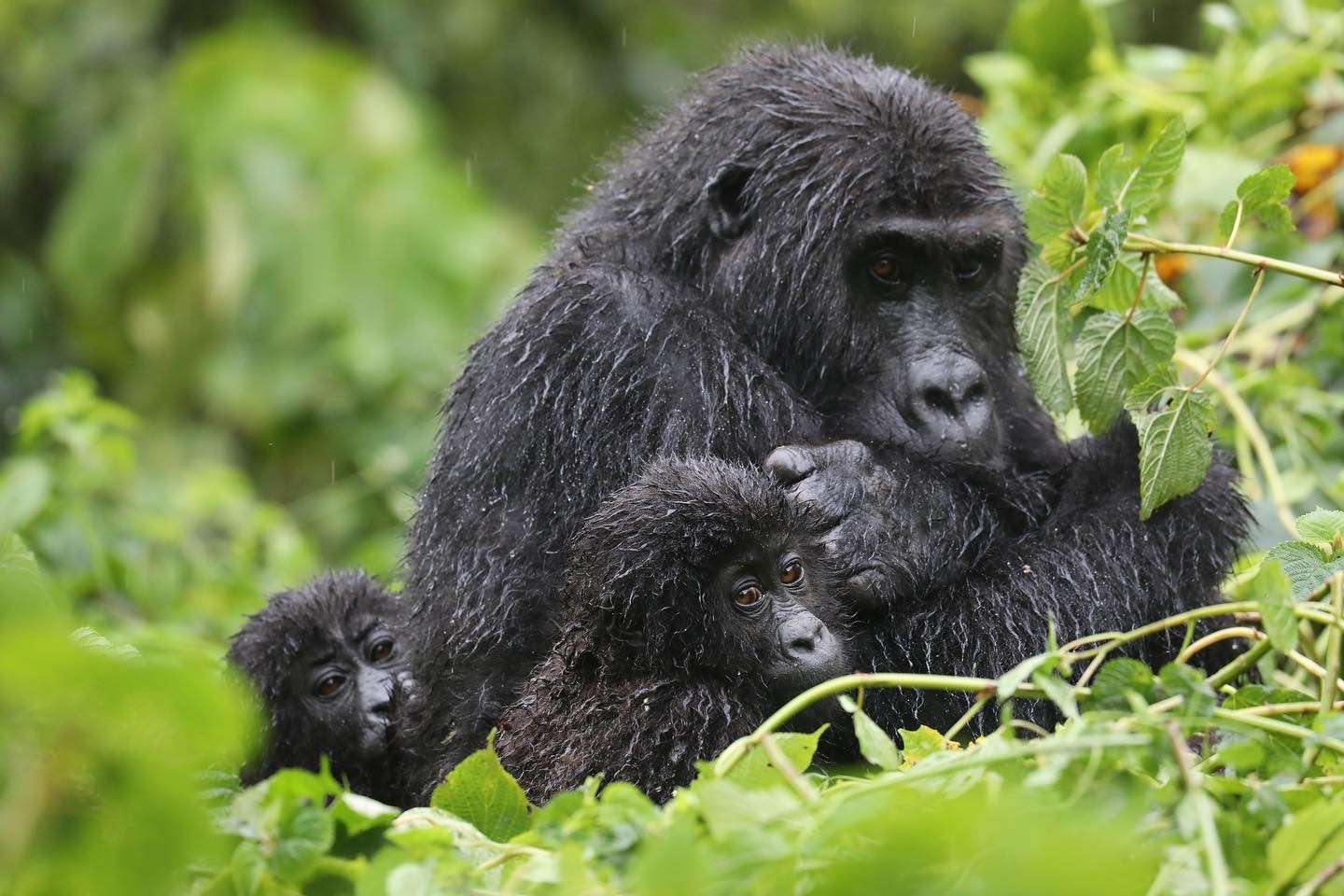
Eastern lowland gorillas in Kahuzi-Biega National Park in the DR Congo. Photo: Miroslav Bobek, Prague Zoo
ZOOPRAHA.CZ
Contacts
- The Prague zoological garden
U Trojskeho zamku 120/3
171 00 Praha 7
Phone.: (+420) 296 112 230 (public relations department)
e-mail: zoopraha@zoopraha.cz
Others