



Reintroduction of the Ural Owl
One of Central Europe’s largest owls went extinct in both Czechia and Austria at the beginning of the 20th century. Today, this critically endangered species is once again a permanent resident of the Bohemian Forest, with Prague Zoo having taken part in its reintroduction. We are also helping to restore its population in Austria.
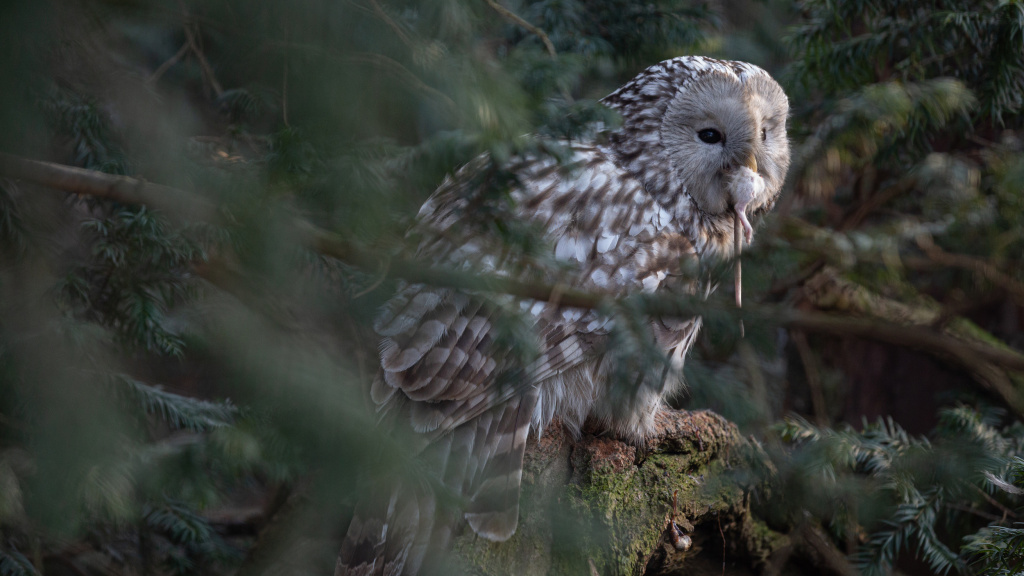 Ural owl. Photo: Tereza Mrhálková, Prague Zoo
The Ural owl (Strix uralensis) is the second-largest owl in Czechia after the Eurasian eagle owl, and its westernmost range lies in the region along the Czech-German border. Within Central Europe it is most numerous in the Bohemian Forest and the Bavarian Forest, where the population is estimated at more than twenty pairs, with optimistic estimates suggesting as many as fifty. In the past, however, it disappeared entirely from Czechia, Germany and Austria due to the loss of original primeval forest, population isolation and direct persecution.
The return of Ural owls to the Czech-German borderlands began in the 1970s on the Bavarian side and in the 1990s on the Czech side. Initially, owls were released mainly in the Upper Palatine Forest mountain range, and from 2008 the releases focused on the Bohemian Forest. Prague Zoo first joined the project in 2009, providing its own offspring—only a year after the first chick had hatched at the zoo following the re-establishment of the breeding programme. A further three chicks were supplied the following year. They were transported together with their parents to adaptation aviaries, where they spent several weeks before the young were separated and released. The parent pair returned to the zoo, where they could continue breeding.
The Bohemian Forest population began to stabilise rapidly, not least because the owls readily accepted artificial nest boxes and began breeding in them. With an estimated twenty breeding pairs, the Bohemian Forest reintroduction project was cloncluded in 2010, and the population is now monitored only. Today, the Ural owl can be considered a stable species in Czechia, thanks chiefly to the release of 106 young birds from breeding centres and zoological gardens.
The situation remained alarming, however, in Austria, which could form an important bridge between the population in the Bohemian–Bavarian Forest region and those in Slovakia and Slovenia. In 2013, we therefore supplied two Ural owls from a genetically valuable line to the Richard Faust Centre of the Owl & Birds of Prey Rescue Station in Haringsee near Vienna, so that they could take part in the Austrian reintroduction programme. In 2021, we delivered the first three owls from our breeding to be released directly within the Ural Owl Reintroduction project (Habichtskauz Wiederansiedlung) led by Dr Richard Zink of Vetmeduni Vienna. A further two owls followed in 2023 and three more in 2024. At two to three months of age they travelled to an adaptation aviary for release, helping to reinforce the Central European Ural owl population, with the hope that the species will soon be stable throughout its original range.
Based on a text by Antonín Vaidl for the Trojský koník magazine
Further reading
Prague Zoo is intensely involved in the protection of animal species, whether they live under human care or in their natural habitats. Join us in helping them to survive!
| Total zoo area | 58 ha |
| Total exhibit area | 50 ha |
| Number of pavilions | 15 |
| Number of exhibits | over 150 |
| Number of employees | 249 |
ZOOPRAHA.CZ
Contacts
- The Prague zoological garden
U Trojskeho zamku 120/3
171 00 Praha 7
Phone.: (+420) 296 112 230 (public relations department)
e-mail: zoopraha@zoopraha.cz
Others