



First Przewalski's Horse Foal Born in Kazakhstan!
A Przewalski’s horse foal was born in central Kazakhstan for the first time in hundreds of years. Its parents are the mare Tessa, originally from Tierpark Berlin, and the stallion Zorro from Prague Zoo’s breeding programme. Both arrived in the country in June 2024 as part of the first transport of Przewalski’s horses to the Golden Steppe, organised by Prague Zoo and its partners. It was one of three such transports carried out so far. According to initial observations, the little colt is thriving and regularly drinking milk from his mother. Together with other mares, he is currently living in an acclimatisation enclosure at the Alibi reintroduction centre on the edge of the Altyn Dala State Nature Reserve. The horses are cared for by colleagues from the Association for the Conservation of Biodiversity of Kazakhstan (ACBK).
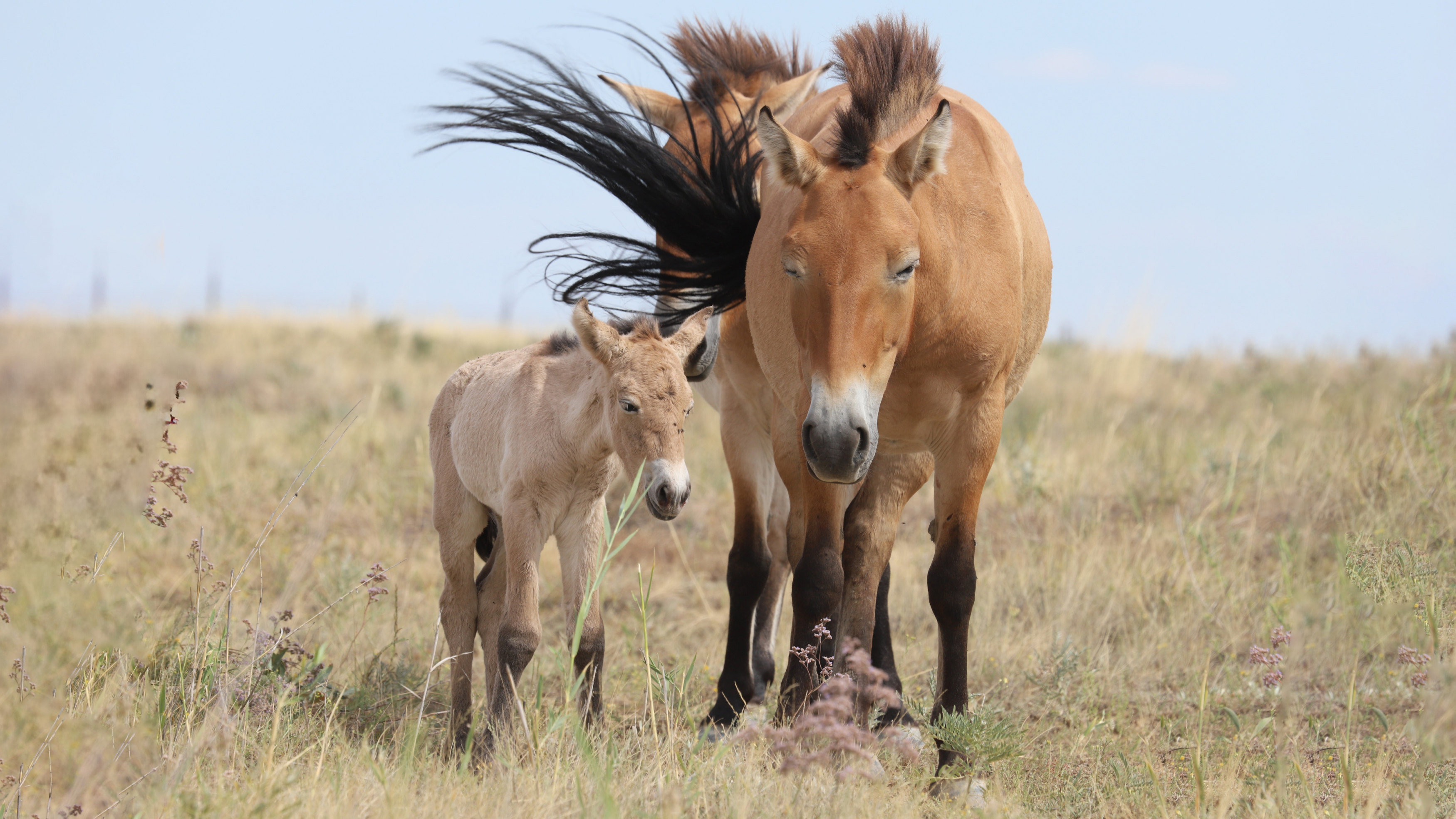 The first photograph of a Przewalski’s horse foal born in central Kazakhstan. Photo: Kanat Batyrkhanuly, ACBK
“The birth of the foal is one of many steps on the road to the successful reintroduction of this species into the wild in Kazakhstan. Nevertheless, it is a crucial milestone, as well as a very joyful and tangible one,” said Lenka Poliaková, Director of Prague Zoo. “Restoring a viable population of an extinct species to its native range is an exhausting mission full of challenges. But news like this gives everyone involved in the Return of the Wild Horses project the energy they need to keep working towards our goal,” she added.
The foal is the first Przewalski’s horse to be born in the region from which this last truly wild horse disappeared more than 200 years ago. Its extinction in the wild was caused primarily by hunting and pressure from farmers and livestock breeders.
“A Przewalski’s horse colt with Czech blood has been born in the Golden Steppe, and above all I wish him a happy life, plenty of siblings and, in the future, offspring of his own. Only then will the Return of the Wild Horses project, which is the flagship of Prague Zoo’s conservation initiatives, be truly successful. I would also like to take this opportunity to once again thank not only our zoo team for the demanding transports, but also our visitors, because CZK 8 from every admission ticket goes directly towards biodiversity conservation projects,” said Jana Komrsková, Deputy Mayor of Prague for the Environment.
The colt was born on 22 August. He is only the first offspring of seven-year-old Tessa, but she is taking excellent care of him. She stays constantly by his side, vigorously defending him from the other mares’ attention, and regularly lets him suckle.
“The birth of the first foal is the result of a huge amount of work that began long before the horses arrived in Kazakhstan. Preparing the site and infrastructure, organising the complex logistics required to transport the animals, their acclimatisation, and the daily monitoring and care provided by specialists—all of this was essential to ensure that the horses adapted successfully. We now have a new task: to monitor the growth and development of the first Przewalski’s horses born on Kazakh soil. We hope that this first generation will be the beginning of a self-sustaining population,” said Vera Voronova, Director of ACBK.
There could be more foals in Kazakhstan in the coming weeks. Two other mares at the Alibi reintroduction centre are also expected to give birth.
The news has brought particular joy to the new mother’s original home: “Tessa was born in Berlin and was transferred to Kazakhstan in 2024. The birth of her foal is a truly exceptional and important step in our long-term efforts to reintroduce the Przewalski’s horse,” said Christian Kern, Zoological Director of Tierpark Berlin and Berlin Zoo. “Reintroducing wild animals into their natural environment carries responsibility, challenges and risks. This makes us all the more delighted by this success, and we would like to extend our heartfelt thanks to all our partners.”
The Przewalski’s horse is the last surviving species of truly wild horse. The Western world only became aware of its existence in 1881. Less than a century later, in the 1960s, it became extinct in the wild. It was saved from extinction through captive breeding, with Prague Zoo playing a key role in its conservation. Since 1959, Prague Zoo has maintained the International Studbook for the Przewalski’s horse. Nowadays, it also organises transports of horses from Europe to their homeland—specifically to the steppes and semi-deserts of Mongolia and Kazakhstan—in cooperation with the Czech Air Force.
Following the successful reintroduction of Przewalski’s horses to the Great Gobi in Mongolia, Prague Zoo began transporting horses to the Golden Steppe in Kazakhstan in 2024. The project is carried out in cooperation with the Committee of Forestry and Wildlife of the Ministry of Ecology and Natural Resources of the Republic of Kazakhstan, Hortobágy National Park, Nuremberg Zoo, Frankfurt Zoological Society, and the aforementioned ACBK and Tierpark Berlin.
More about the Return of the Wild Horses project: https://www.zoopraha.cz/en/return-of-the-wild-horses
ZOOPRAHA.CZ
Contacts
- The Prague zoological garden
U Trojskeho zamku 120/3
171 00 Praha 7
Phone.: (+420) 296 112 230 (public relations department)
e-mail: zoopraha@zoopraha.cz
Others