


Veterinary Training for Prague Zoo’s Youngest Giraffe
Johanka, a Nubian giraffe, is currently being trained for veterinary examinations. She is Prague Zoo’s first giraffe to be trained by keepers daily. They use a “target”, treats such as giraffe treats, and the one-and-a-half-year-old animal’s youthful nature. Visitors to the African House can see this regular training as it happens. At first it may seem to be simple petting; however, it is, in fact, a sophisticated method.
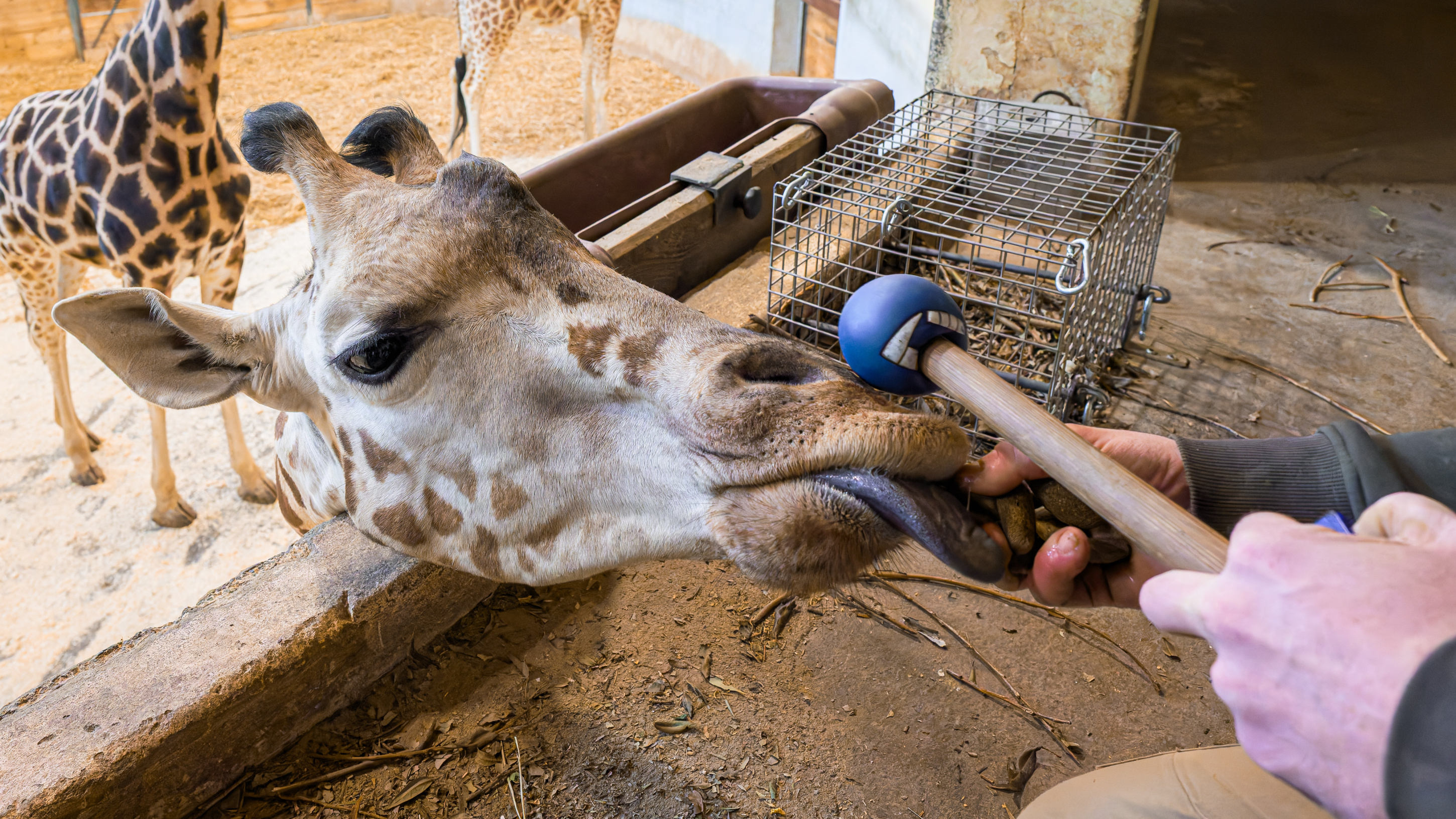 It is important to check the mouth as giraffes can sometimes injure them when they play tug of war with branches. Photo: Petr Hamerník, Prague Zoo
Aleš Doležal, the zoo’s head breeder, said, “Johanka already lets us touch her head so we can check her eyes, ears, horns and mouth. She has learned to respond positively to our target, which consists of a short stick with a blue ball. She now associates its presence and a click of the clicker with treats; this allows us to get her on the weighing scale, for example.”
Although the young giraffe is quick to learn, the desired goal is still some way off. The ultimate aim is to be able to take a blood sample from the jugular vein. Given these ungulates’ height, a voluntary method conditioned by positive motivation would save both the giraffe and the zoo workers the stress involved in anaesthesia.

While the target and treats keep the giraffe busy, the second keeper can check its eyes and ears for inflammation and its horns for occasional grazes. Photo: Petr Hamerník, Prague Zoo
Doležal went on to say, “I used to look after the elephants, which are more perceptive, less reserved. Working with giraffes is different because they are actually very shy animals and it takes a long time to gain their trust.” He believes it is best to start training a giraffe at a young age. Young animals are less cautious and more open to new things.
Now, people are more likely to see the herd of Nubian giraffes in the indoor exhibition at the African House. However, even in winter, it is not uncommon for the herd of seven to go for walks in the huge enclosure. If there is no wind, the sun shines and the ground is not icy, then even temperatures just above zero do not pose the slightest problem to the giraffes.

When training Johanka, it was interesting to note that Nsia (pictured in the background), who is almost 16, seemed to remember her training and now also comes to the keepers’ target. Nsia is from Marwell Zoo in the UK, where she was regularly trained in her youth. Seen here, from left, head keeper Aleš Doležal and Daniel Jančařík. Photo: Petr Hamerník, Prague Zoo
ZOOPRAHA.CZ
Contacts
- The Prague zoological garden
U Trojskeho zamku 120/3
171 00 Praha 7
Phone.: (+420) 296 112 230 (public relations department)
e-mail: zoopraha@zoopraha.cz
Others