Help for Birds

Do you love nature and would like to support the birds around you? There are many ways to help—and even the smallest effort counts! Below you will find tips on how to help birds, as well as advice on how to avoid harming them unintentionally.

Photo: Martin Smrček
A Place to Live
The more diverse the environment, the more species it can support. Some birds nest in dense shrubs, others use piles of wood, some hunt insects while others feed on seeds. If you have a garden, plant shrubs and trees (especially those bearing edible fruits), a wide variety of flowers (ideally native species), avoid chemical sprays, mow less frequently, and provide a bird bath or a small pond. Birds—and many other animals—will appreciate it.

Most people consider thistles to be unwanted weeds, but for goldfinches, their seeds are a welcome source of food. Photo: David Maw / CC0, Pixabay
When choosing shrubs for birds, it is best to combine deciduous and evergreen species, select plants of varying heights, and ensure they bear fruit at different times of the year. Some provide shelter from predators and safe nesting sites within their dense or thorny branches, while others offer berries throughout the year or attract insects on which birds can feed. Climbing plants should not be overlooked either—they can serve as valuable nesting sites or sources of food. However, to allow birds to build nests in dense vegetation, pruning should be avoided during the nesting season.
Woody plants suitable for a bird-friendly garden and native in Central Europe include rowan, guelder rose, dog rose, common dogwood, black elder, blackthorn, common hawthorn, cornelian cherry, bird cherry, ivy, privet and spindle. A note of caution: although its fruits are readily eaten by birds, spindle is highly toxic to mammals, including humans. Among the species that are not native in Central Europe but are popular among birds, we can mention serviceberry, chokeberry, Russian olive, scarlet firethorn and snowberry.
An ideal bird garden—or, more generally, a wildlife-friendly garden—is diverse and a little “untidy”. A neat, closely mown lawn with carefully trimmed conifers offers very little space for wildlife. By contrast, a naturally growing (untrimmed) mixed hedge, a lawn allowed at least partly to grow longer, or a brush pile made of pruned twigs from fruit trees or vines that provides shelter for small animals, including shrub-nesting birds—these are all features that birds will appreciate.

Even an ordinary terracotta plant saucer can serve as a bird bath. Photo: Andrew Martin / CC0, Pixabay
Nest Boxes
Some birds nest in cavities, but old hollow trees are increasingly rare. To support birds, you can install nest boxes. Many different types are available to buy, each suitable for different species—from tits to owls. Skilled DIY enthusiasts can also make their own. It is important that the box can be opened for cleaning. Place it out of reach of predators and in partial shade to prevent chicks from overheating.
The ideal time to put up nest boxes is in autumn. At first glance this may seem surprising, as birds do not breed in autumn or winter, but it allows them time to become familiar with the box. In addition, species that remain over winter often begin selecting nest sites during the winter months. Migratory species, on the other hand, should have nest boxes installed in late winter or early spring, when they return from their wintering grounds. This helps ensure that suitable nesting sites are still available for them. Putting up a nest box is not the end of the work. It is equally important to clean, check and repair it after each breeding season. Only then will it continue to serve birds well.
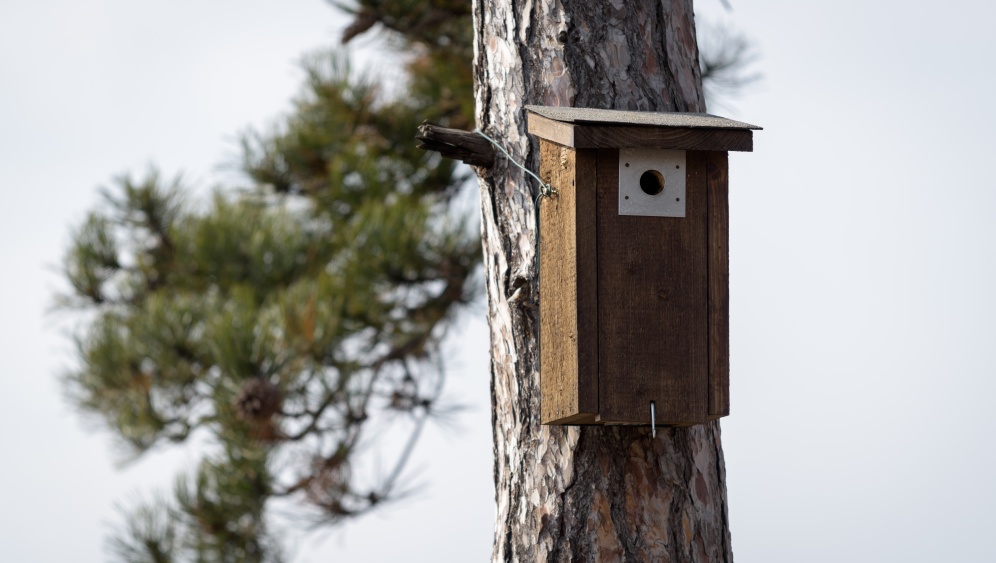
An example of a nest box installed within Prague Zoo. A metal plate around the entrance protects the nest from woodpeckers and squirrels; the overhanging roof, sloping down towards the front, directs moisture away; and the entire front panel can be opened for inspection and cleaning. Photo: Petr Hamerník, Prague Zoo
Nest boxes should be placed at least 15 metres apart. Installing several boxes of the same type close together usually means that some will remain unoccupied. Larger species tend to nest higher up, while small passerines are often content with boxes placed lower (sometimes even at eye level). However, if there is a risk of frequent disturbance due to human activity, it is better to position the box slightly higher.
A combination of measures can be used to protect nest boxes from predators. It is advisable to place the box so that it does not stand out in the landscape and attract attention. Moving it to a different location each year can also make it harder for long-lived predators to locate it from memory. A taller or deeper box ensures that, even if a cat or marten discovers it, they cannot reach the nest or chicks with their paws. A similar effect can be achieved with a barrier behind the entrance hole, an extended entrance, or an overhanging roof. To deter squirrels and woodpeckers—which may enlarge the entrance hole to gain access—metal reinforcement around the entrance, or even on parts of the front or sides, can be effective. And one more important point: do not add a perch below the entrance hole. Birds do not need it, and it only makes access easier for predators, which can use it as a foothold.
Helping in Winter
Watching birds brings both knowledge and joy. Classic bird feeders, however, often benefit common species at the expense of rarer ones. In addition, feeders can facilitate the spread of diseases such as trichomonosis, which is fatal to birds and has, in some areas, completely decimated populations of greenfinches in recent years. The origin of the food may also be associated with a considerable environmental burden (for example, grains grown using large amounts of pesticides and transported over long distances).

Edible berries provide a natural winter food source in the garden for species such as this bullfinch. Photo: Alex Kantsur / CC0, Pixabay
The best way to help birds is to provide a natural “buffet” in your garden. Leave seed-producing plants standing after they have finished flowering instead of cutting everything back; do not rake up fallen leaves, as they shelter insects; and plant native berry-bearing species that birds can feed on during winter.
If you choose to help by putting up a feeder as well, follow these guidelines:
- Sweep out the feeder daily and disinfect it once a week to prevent it from becoming a source of infection.
- Where possible, choose feeder types where birds do not sit directly in the food, for example tubular feeders with feeding ports at the bottom.
- Food should be protected from moisture (rain or snow) to prevent it from getting mouldy.
- Bread, salt, spices and leftovers from human cooked food are harmful to birds.
- The plastic nets on shop-bought fat balls can become deadly traps. Place fat balls in a wire feeder instead.
- Several small feeders are better than one large one.

This type of feeder keeps the food dry and reduces the risk of contamination by droppings. Photo: CC0, PxHere
Common feeder visitors will welcome sunflower seeds (both hulled and unhulled), crushed nuts or peanuts, fat (for example in the form of fat balls or homemade hanging feeders), mealworms, and cereal grains such as oats, millet or wheat. Fat mixtures can be packed into coconut shells, wedged into the gaps of opened pine cones, or pressed into holes drilled in a log. Cereal grains can be offered not only whole but also as flakes, which are even more suitable for some species. The more varied the food and the ways it is offered, the greater the diversity of birds that will visit.
Do not forget species that primarily forage on the ground, such as blackbirds, robins or chaffinches. Raised feeders are inconvenient for them, and they often cannot perch on small feeders at all. However, food can be provided for them on a shallow dish placed in a sheltered spot under a dense shrub or conifer. Suitable foods include cereal flakes, hulled sunflower seeds, mealworms, chopped peanuts and fat-based mixtures. In this case, however, it is better to crumble the mixture into small pieces, as blackbirds and robins have weaker beaks than tits or woodpeckers, and a whole fat ball is too hard for them to peck at easily.
Hidden Threats
Around our homes, birds often encounter deadly hazards. These can, however, be avoided.
Glass surfaces
Up to a million birds die each year after colliding with glass in the Czech Republic alone. Birds cannot see glass surfaces—whether windows, shop fronts or bus shelters. Prevention means making glass visible to birds, for example with curtains, blinds or stickers. UV stickers are also available; these are clearly visible to birds but barely noticeable to people.
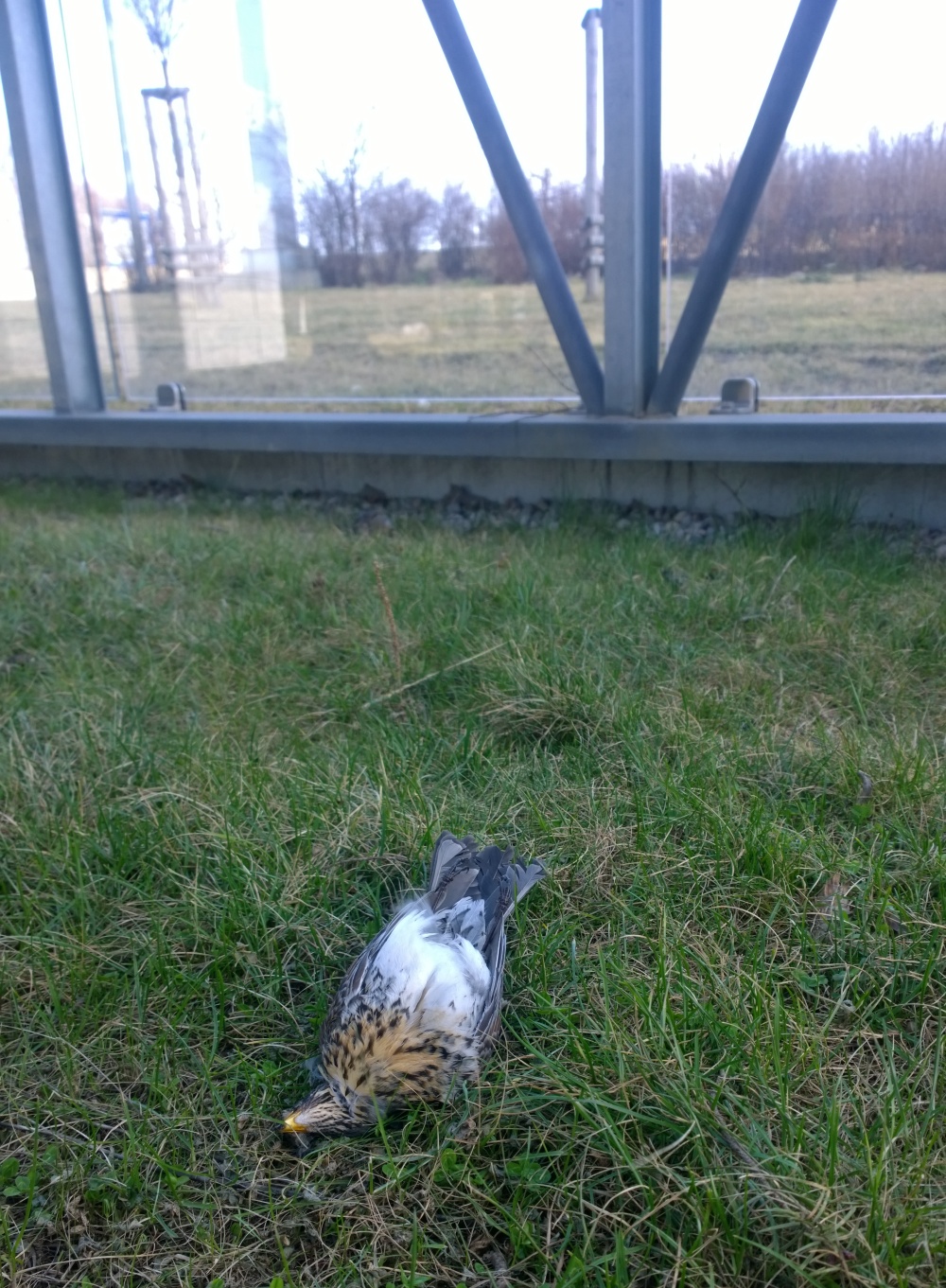
Collisions with glass surfaces are among the most common human-related causes of bird mortality in the Czech Republic. Photo: Petr Stýblo, Czech Union for Nature Conservation
Water containers
Swimming pools and water barrels cannot be climbed out of due to their steep and smooth-sided edges. Drinking or bathing can quickly turn into a fight for survival. Such containers should therefore be covered or fitted with a floating object and a mesh “ladder” leading to the edge, allowing animals to climb out.
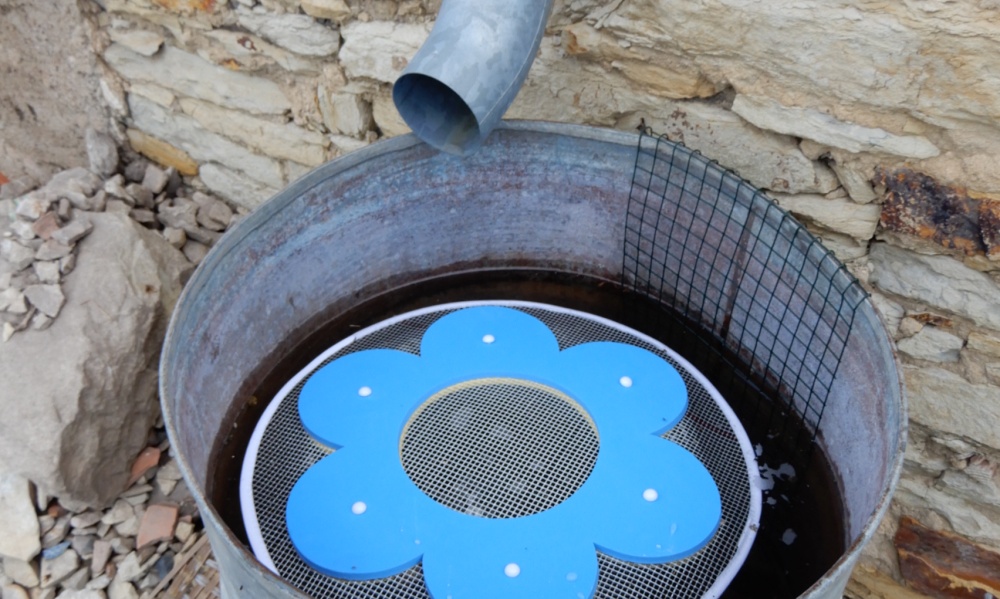
If a water container cannot be covered, it should be fitted with a floating object and a mesh “ladder” to prevent small animals from drowning. Photo: Miroslav Bažant, Czech Society for Ornithology
Plastic nets
Birds can easily become entangled in them and are unable to escape. This applies not only to nets protecting berry shrubs, but also to the nets around shop-bought fat balls. Fat balls should therefore be placed in a wire tube feeder, and dense mesh should be used to protect fruit bushes, as birds will not become entangled in it.
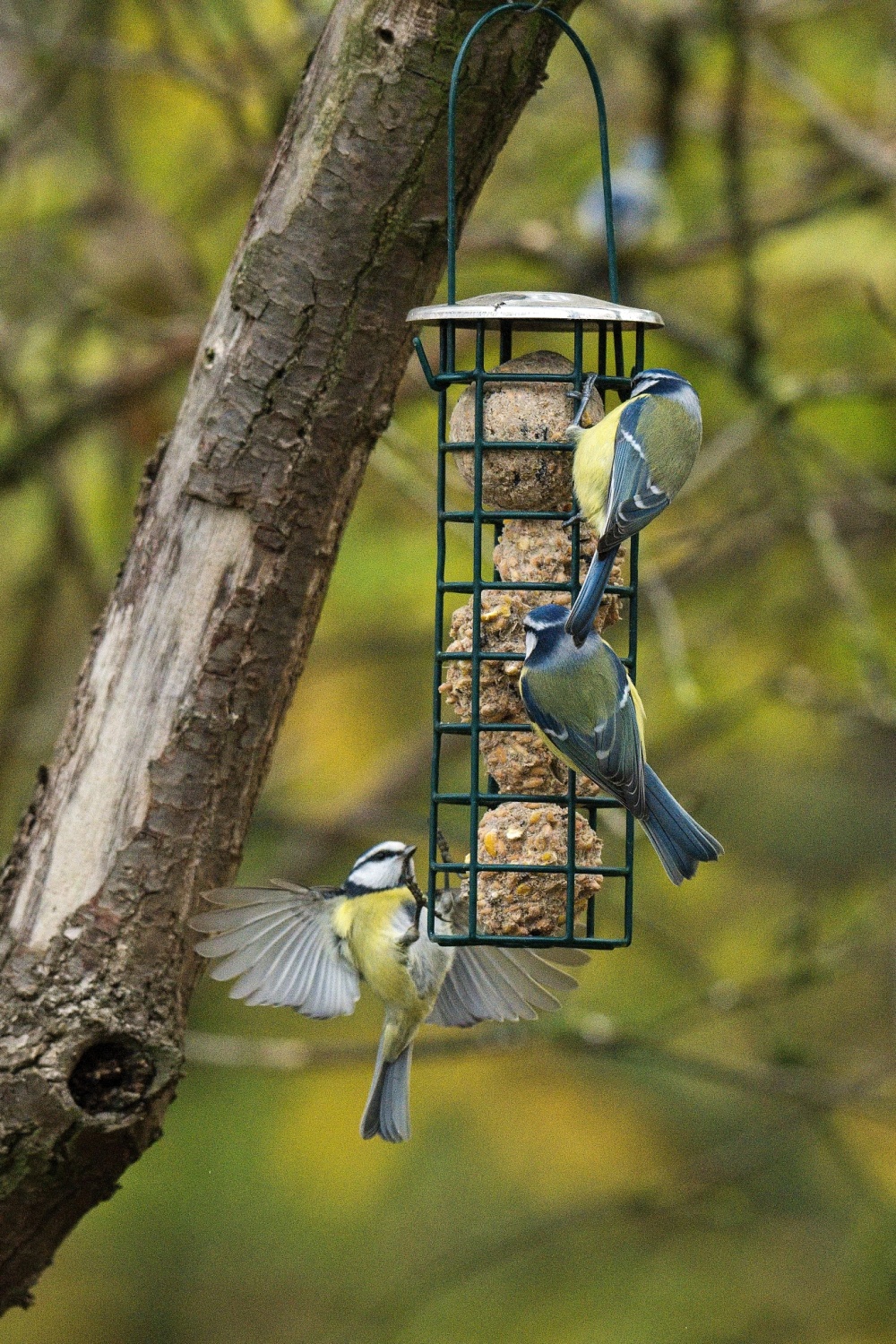
Fat balls are usually sold in plastic nets, but it is far better to place them in a wire tube feeder like this one. Photo: Miloslav Anderle, Czech Society for Ornithology
Vertical cavities
Falling into a chimney, gutter, ventilation shaft or upright pipe is usually fatal—the walls are smooth and there is no space to fly. The solution is to cover openings with grilles and to lay loose pipes horizontally.
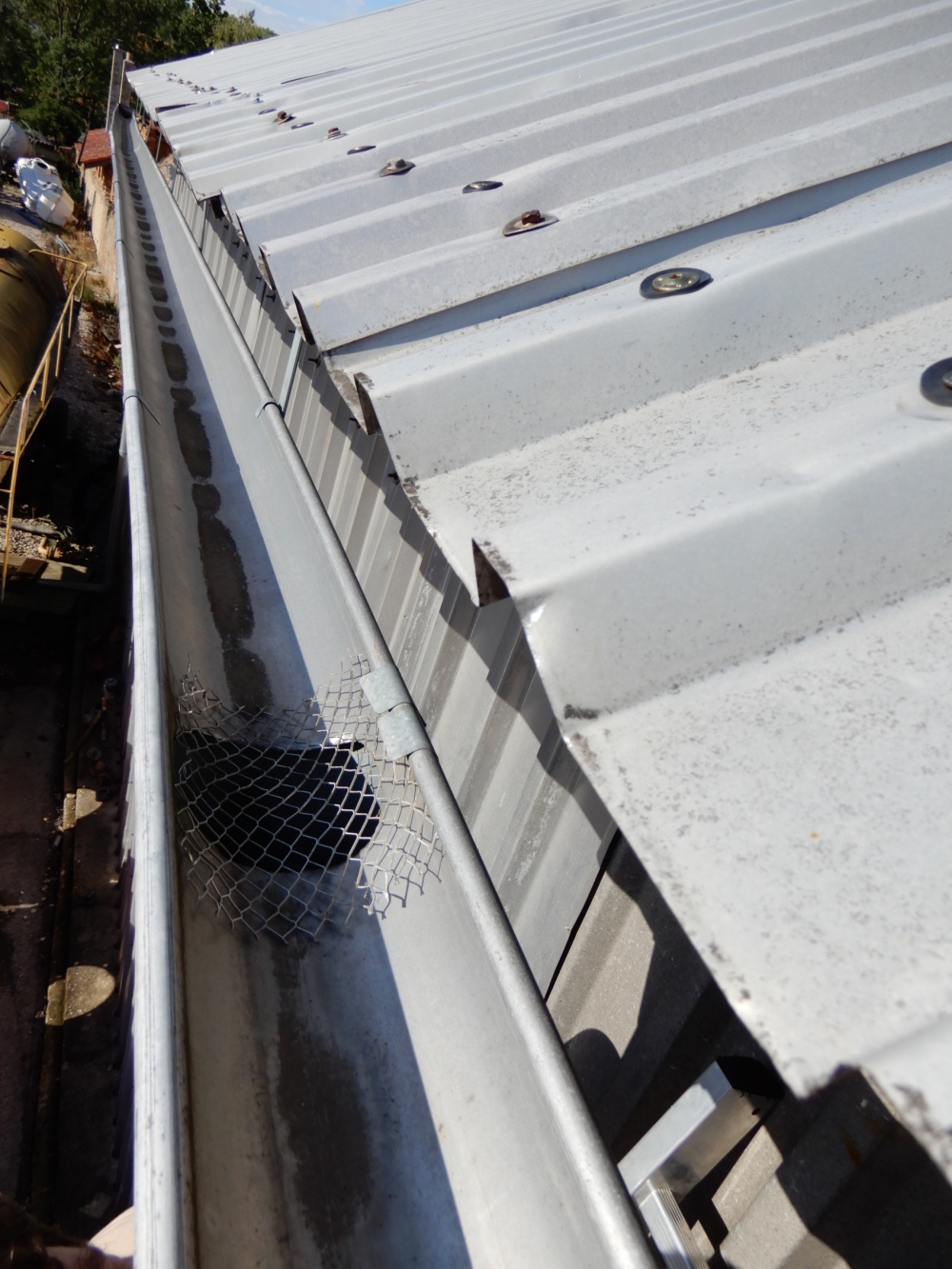
Downpipes can be dangerous for birds, but the solution is simple: cover the opening with a grille. Photo: Miroslav Bažant, Czech Society for Ornithology
Glue traps
Although intended for insects, birds and other small animals often get stuck to them as well. They then die from exhaustion or suffer fatal injuries while trying to escape. The only truly safe solution is to not use glue traps at all—whether flypapers, ant traps, sticky bands placed on tree trunks against winter moths, or adhesive boards used against pests such as cherry fruit flies..
Useful Links
- Cornell Lab of Ornithology
- BirdLife International
- Czech Society for Ornithology
- Czech Union for Nature Conservation
Menu
Social networks