Cattle, Zebus and Relatives

The familiar European cows belong to the species known as domestic cattle. There are, however, several other species of large domestic bovines, including zebu, water buffalo and yak. Let us take a closer look at them.
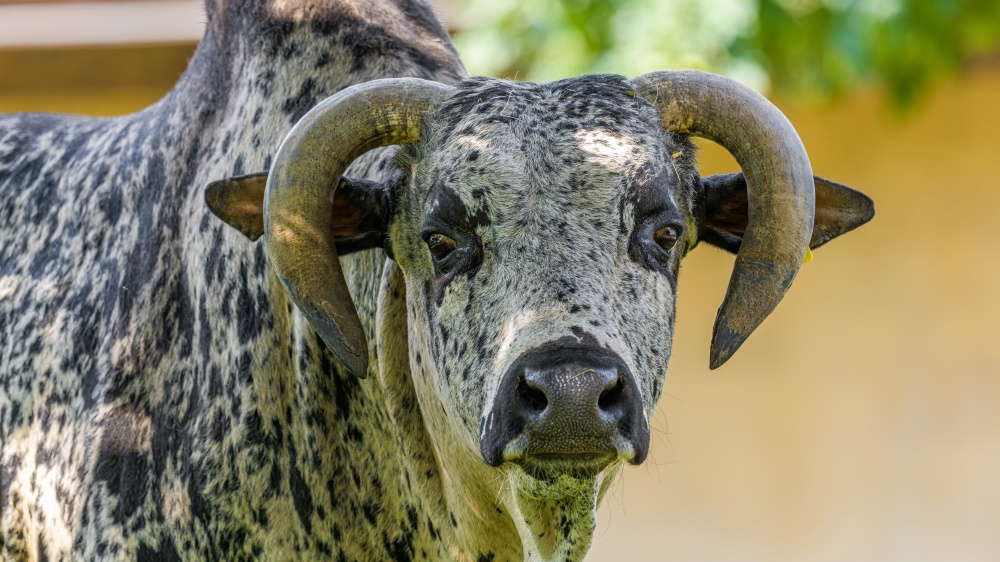
Photo: Petr Hamerník, Prague Zoo
Domestic Cattle (Bos taurus)
Also referred to as taurine cattle or simply cattle, it is the most widespread form of large livestock in Europe. Their ancestor was the now-extinct aurochs (Bos primigenius), domesticated around 10,000 years ago in the Near East, in the region of the Fertile Crescent. Initially, cattle were kept as sacred and sacrificial animals and for meat, known as beef, but by the 3rd millennium BCE usage of cow milk is already documented, and the use of cattle as draught animals—for ploughing fields or pulling carts—also has very ancient roots.
The uses of cattle are, however, far more diverse. Hides are processed into bags, shoes, belts and jackets; bones are used to produce so-called bone china; boiling bones, hides, cartilage and tendons yields gelatine; and dung can be used as fertiliser, fuel or even a building material. In some regions it is even incorporated into plaster, used to disinfect floors, or applied in medicinal poultices. Of specific role is usage of cattle in bullfighting or in landscape management.
Taurine cattle and zebu can interbreed and produce fertile offspring, and many African breeds are of mixed origin, making it difficult to determine how many animals belong to each group. Taken together, however, the global population of domestic cattle and zebu approaches one billion. Cattle occur in a wide range of colours and sizes; they may be horned or polled, and there are even long-haired breeds adapted to harsher climates (such as Highland cattle). In the Czech Republic, the most common dairy breeds are the black-and-white Holstein and red-and-white Czech Fleckvieh, while beef breeds include the cream-coloured Charolais, black Aberdeen Angus and red-and-white Beef Simmental (pictured).
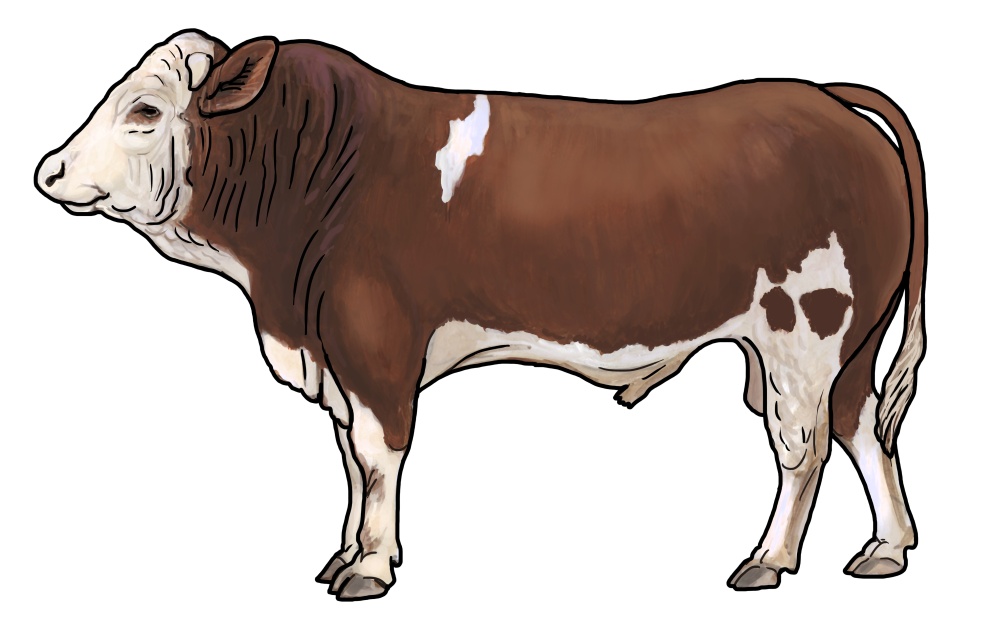
Illustration: Ivana Hanzlíková
Zebu (Bos indicus)
Also known as indicine cattle or humped cattle, zebus descend from the now-extinct Indian aurochs (Bos namadicus, regarded by some authors as a subspecies of the Eurasian aurochs, i.e. Bos primigenus namadicus). They were domesticated on the Indian subcontinent around 8,000–9,000 years ago, and their wild ancestor became extinct more than 5,000 years ago (the first of the aurochs forms to disappear).
Zebus produce less milk than taurine cattle but are superbly adapted to hot climates, resistant to tropical diseases, and able to endure longer periods without water thanks to fat reserves stored in the hump above the shoulders. They are therefore far better suited than taurine cattle to dry tropical regions with poor grazing. They are used both as draught animals and for milk production.
In India, they are considered sacred and their meat must not be eaten. Elsewhere in the world, they are, however, used for meat, hides and other products, being widespread across much of southern Asia, Africa and even South America—for example in Brazil. In Africa, even more common than purebred zebus are representatives of so-called Sanga cattle, which originated from ancient crossbreeding between taurine cattle and zebu and are excellently adapted to local conditions. Some zebu breeds have long drooping ears, others are small in stature, and they occur in a variety of colours, including brindled and spotted. Most commonly, however, they are white, cream, light grey or fawn.
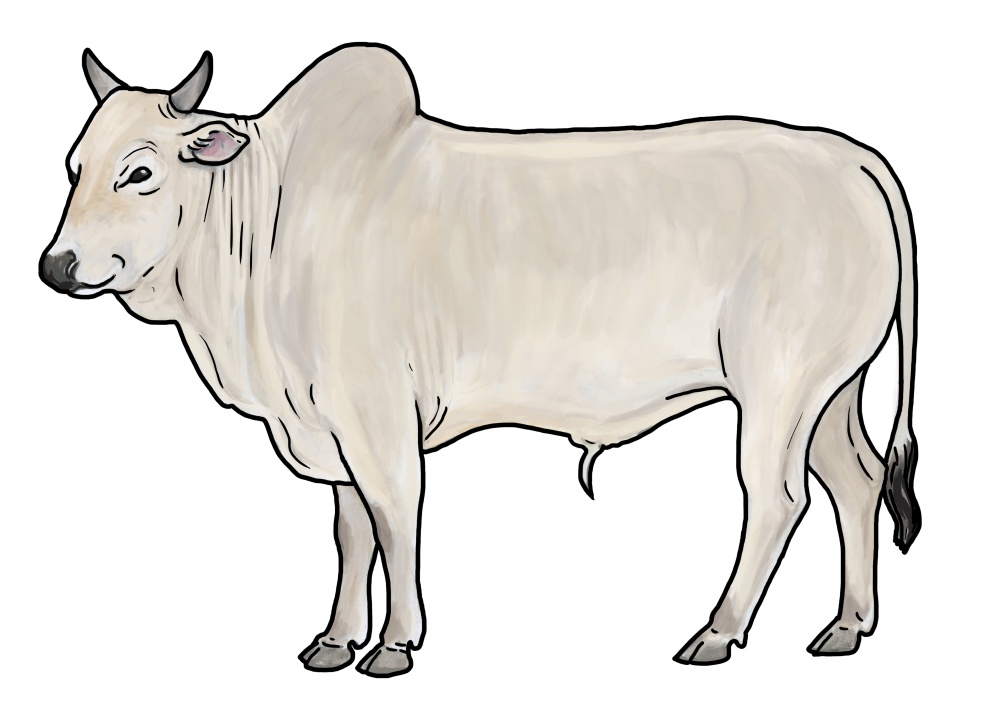
Illustration: Ivana Hanzlíková
Water Buffalo (Bubalus bubalis)
Alongside zebu, the water buffalo is the most important large livestock in the tropics and subtropics. Both are hardy and resistant to tropical diseases, but while zebus cope extremely well with drought and intense sunlight, buffalos thrive in humid monsoon regions with waterlogged soils and need to cool themselves regularly by wallowing in water.
They are hardy, undemanding, strong and enduring animals, used mainly as draught animals for ploughing rice fields or carrying loads. There are also dairy breeds, and in some regions, buffalos are kept for meat or even for fighting and racing. Buffalo dung can be used as both fuel and fertiliser; their tough hides are ideal for straps and various tools; and horns and bones are used to make jewellery such as earrings.
Domesticated around 5,000 years ago, the ancestor of the water buffalo is the Asian buffalo (Bubalus arnee). Unlike other kinds of large domestic cattle, which can often interbreed (though not always producing fertile offspring), buffalos do not cross with other “cattle” species. More than 200 million water buffalos live in the world today, the vast majority in Asia’s warm, wet regions. In Europe, buffalos are kept for example in northern Italy, where their milk is used to make the well-known cheese mozzarella.
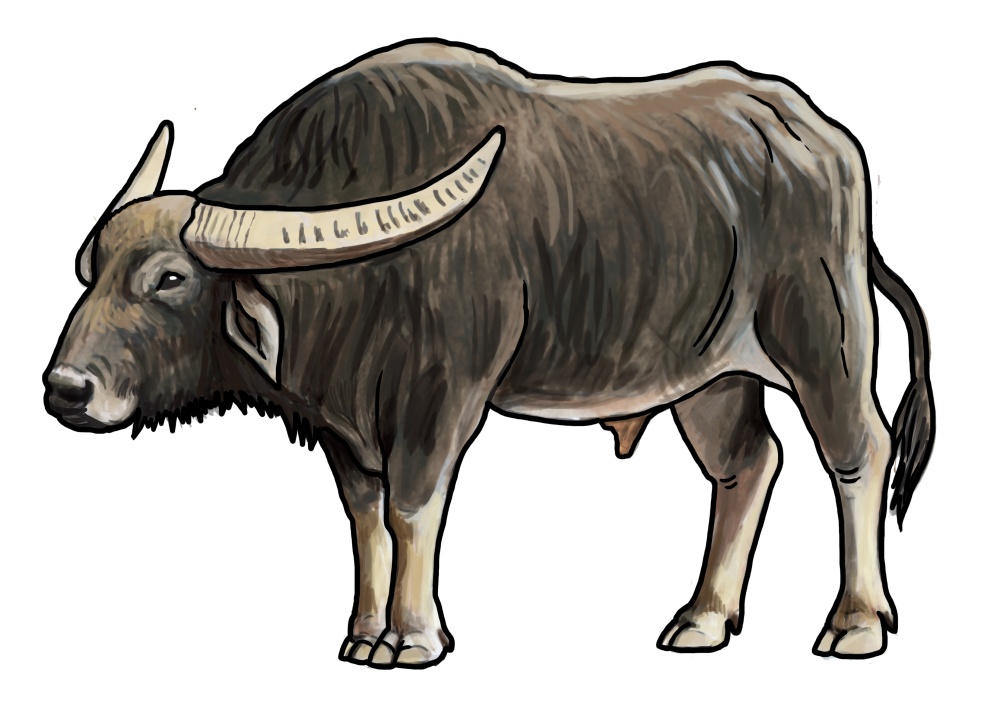
Illustration: Ivana Hanzlíková
Domestic Yak (Bos grunniens)
Also called the hairy cattle, Tartary ox or grunting ox, the yak is an animal without which human settlement of the high-altitude regions of the Himalayas would hardly be possible. It was domesticated from the wild yak (Bos mutus) on the Tibetan Plateau at least 2,500 years ago, possibly earlier, and is superbly adapted to life in these harsh conditions. As one of the few large mammals, it can survive long, severe Tibetan winters with little food and can perform heavy work even in thin air with low oxygen levels.
There are around 14 million domestic yaks in the world today. They are easily distinguished from all other large bovines by the long hair along the lower edge of the body, often hanging almost to the ground. They occur in a wide range of colours, from white through grey, fawn and brown to black, and may also be spotted or roan.
People make use of almost every part of the yak: milk (used to produce fermented dairy products, cheese and butter, which in Tibet is traditionally added to salty tea), meat, hides, horns, hooves and hair, as well as dung, which serves not only as fertiliser but also as fuel and even building material. Yaks are also used as pack animals and according to some theories, this was the original purpose of their domestication.
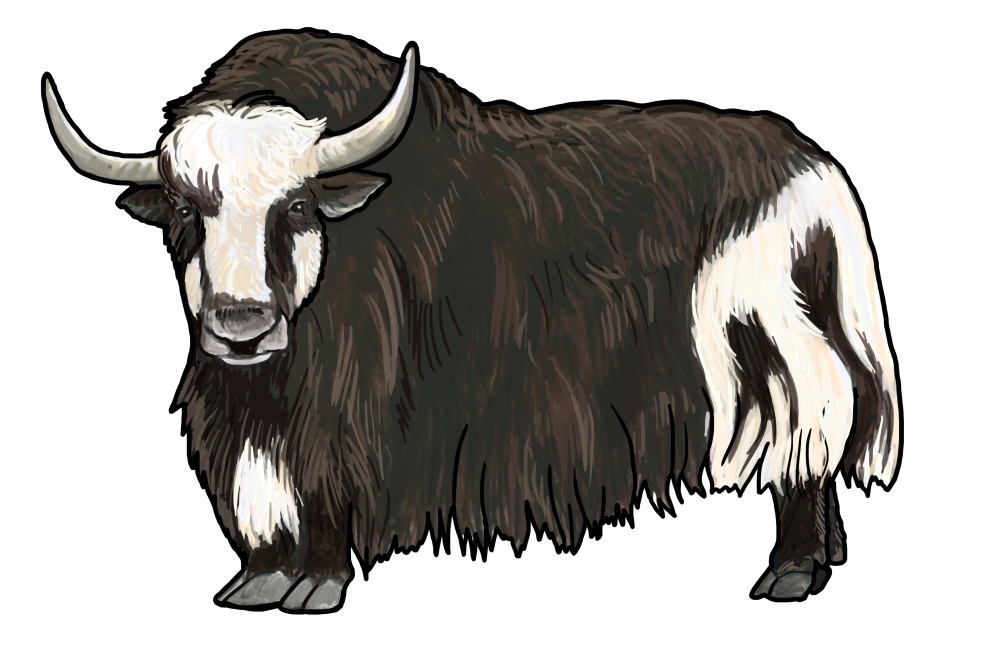
Illustration: Ivana Hanzlíková
Gayal (Bos frontalis)
The gayal was probably domesticated more than 8,000 years ago. Its wild ancestor is the gaur (Bos gaurus)—the largest of all wild bovine species, weighing up to one tonne and inhabiting forested areas of South and Southeast Asia. In its typical dark brown to black colouring, the gayal resembles the gaur, and like it, always has white legs and a pale forehead. It is, however, somewhat smaller (up to 1.8 m in height and usually not exceeding 700 kg in weight), and its horns grow to the sides, whereas those of the gaur curve upwards immediately. In addition to black individuals, animals of other colours, most often spotted, can occasionally be encountered.
Gayals are relatively rare: only several hundred thousand exist worldwide, compared to millions or even hundreds of millions of other livestock species. During the day, they usually roam freely near villages, foraging for grass, bamboo shoots, leaves of shrubs and trees, and various herbs, returning home at night. Owning a gayal is a sign of high social status and wealth, and they are often included in bride price payments. They are used only to a limited extent as draught animals but are valued as sacrificial animals, and their meat is consumed during various celebrations and ceremonies in north-eastern India, Bangladesh and Myanmar. Outside north-eastern India, however, gayal milk is not used.
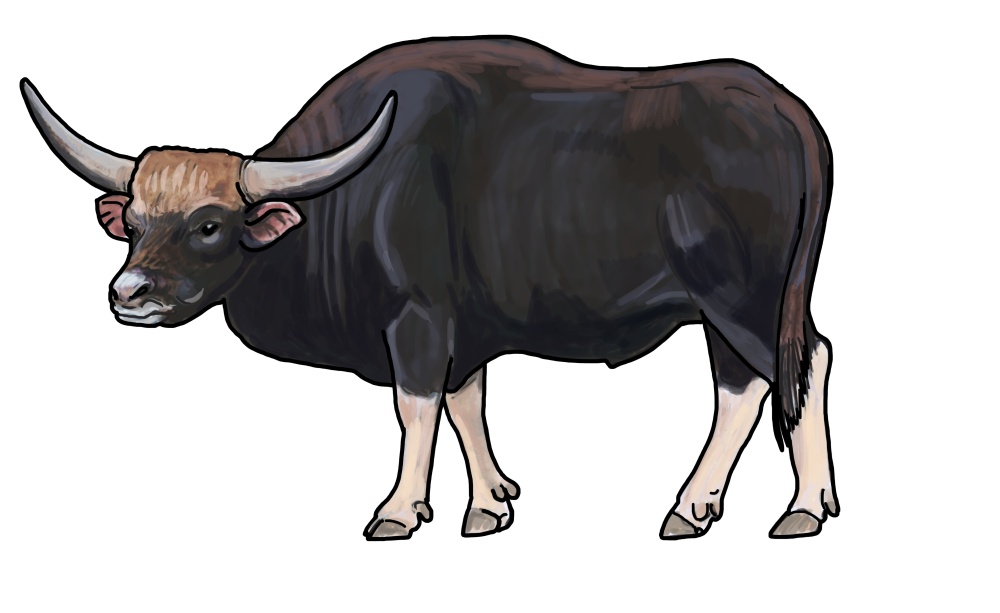
Illustration: Ivana Hanzlíková
Bali Cattle (Bos javanicus domesticus)
Bali cattle descend from the wild banteng (Bos javanicus), a critically endangered species from Southeast Asia. Numbering several million, they are found not only on the island of Bali, where they were domesticated around 5,500 years ago, but also in other parts of Indonesia and neighbouring countries. On islands east of Bali, they are in fact the most common type of cattle. The sexes can be distinguished not only by size but also by colour: bulls are usually dark to black, whereas cows are reddish fawn; more rarely, spotted individuals of either sex occur.
Bali cattle are relatively small: bulls typically weigh no more than 360 kg and cows about 240 kg (for comparison, Czech Fleckvieh cattle reach 1,200–1,300 kg in bulls and 650–750 kg in cows). However, they are highly fertile, hardy and able to thrive where other cattle would struggle. They are not well suited to intensive farming, but for small-scale farmers, who keep them for meat and as draught animals for cultivating fields, they are ideal.
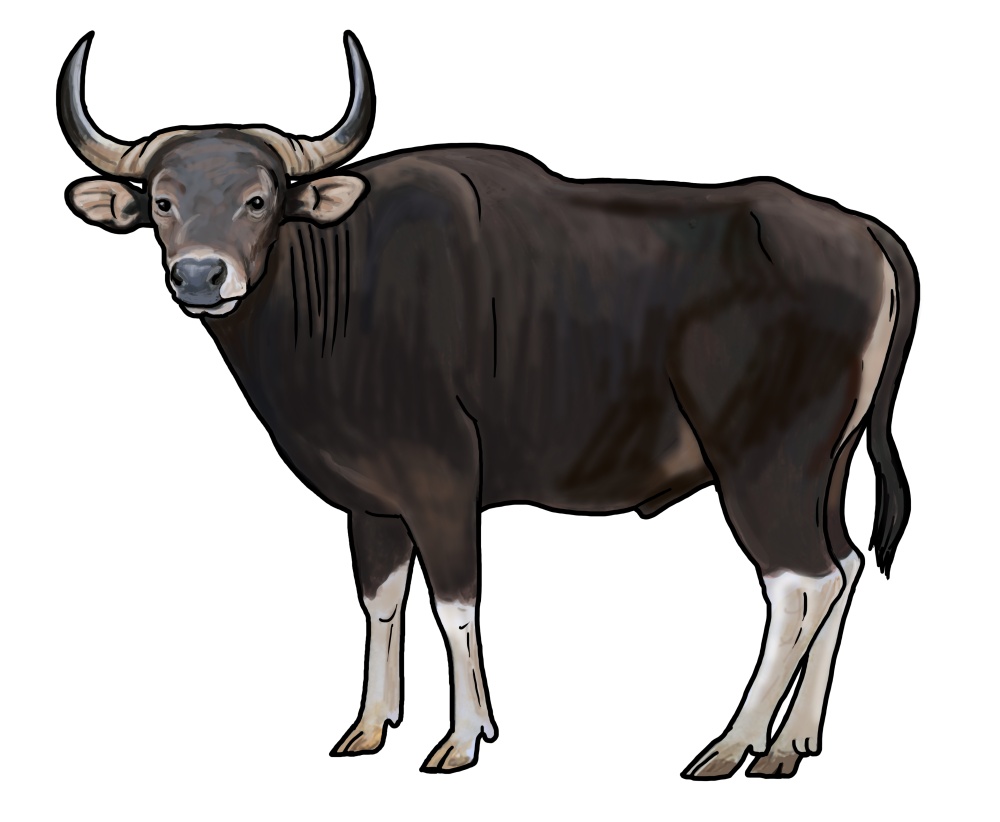
Illustration: Ivana Hanzlíková
Menu
Social networks