Shoebill’s Year
Zoo Praha | 16. 06. 2026

The life of shoebills is closely linked to the alternation of dry and rainy seasons. Heavy rains, lasting from April to October in South Sudan, regularly flood grassy areas. In the ensuing high temperatures, the water evaporates, creating shallow pools that make it easier for shoebills to hunt.
Shoebills live a solitary life throughout most of the year—they roam across vast territories, hunting for food in shallow waters. Even during breeding season, when both partners live together, each one hunts within its own area. The entire breeding period—from nest building to the chick's independence—lasts nearly half a year.
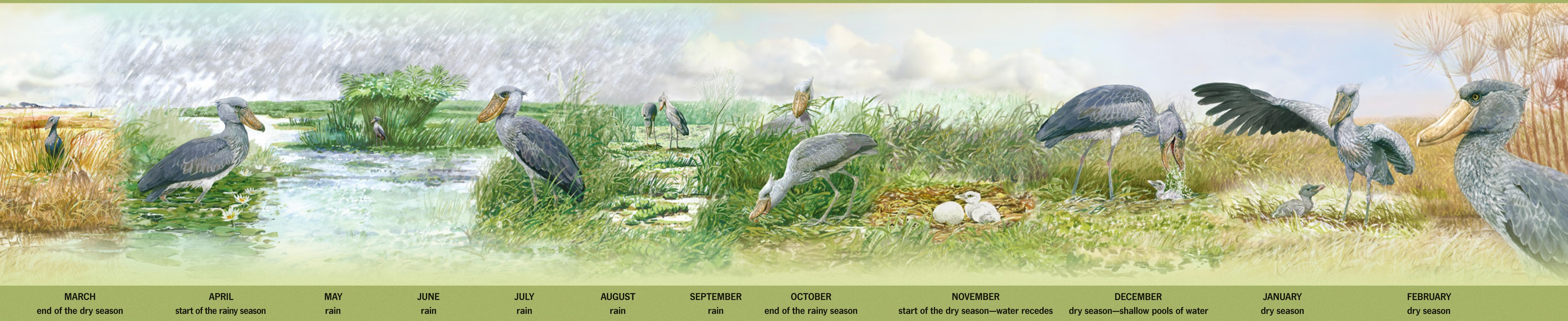
Author: Pavel Procházka
- MARCH
end of the dry season
At the end of the dry season, the area of shallow waters shrinks, reducing the availability of food. More birds therefore gather in the remaining wetlands. - APRIL
start of the rainy season
Shoebills often live in areas with floating vegetation and sometimes hunt in rice fields. However, they do not favour densely overgrown areas with deep water. - MAY
rain
The rainy season brings heavy rainfall. Areas that are usually dry turn into continuous bodies of water, with some fairly deep pools. Shoebills, however, hunt in waters no deeper than half a metre. - JUNE
rain - JULY
rain
The shoebill has several raised spots in its territory that it uses frequently for resting. It usually rests motionless, either standing or lying down. - AUGUST
rain
During courtship, partners perform various bows, raising and lowering their heads. They often clap their bills together as well. - SEPTEMBER
rain - OCTOBER
end of the rainy season
The nest is either on an elevated spot or directly on floating vegetation and is well hidden. The female typically lays 2 eggs at intervals of 2 to 5 days. - NOVEMBER
start of the dry season—water recedes
Parents take turns incubating the eggs. Since they begin with the first one, there is a huge size difference between the chicks, and usually only one survives. Both parents are involved in raising the chick. - DECEMBER
dry season—shallow pools of water
During hot days, shoebill parents use their large bills to carry water to the nest several times a day, gently sprinkling it over the chick to keep it cool. - JANUARY
dry season
In the open landscape, the chick could easily suffer from heatstroke during periods of intense heat. Therefore, the parents protect it by shading it with their broad wings. - FEBRUARY
dry season
The fledgling has yellow eyes and a light-coloured bill. It is able to fly about 14 weeks (3 months) after hatching, but it stays with its parents for another four weeks.
Menu
You’re now using the mobile version of www.zoopraha.cz/en. To view the full version, please click here.
Social networks