Half a Century on, Bongos Return Home from Europe: Four Males Arrive in Kenya
02. 05. 2026
A quartet of critically endangered eastern bongo antelopes, including a male from Prague Zoo, has arrived in Kenya. Nicol Adamcová, the Czech Ambassador to Kenya, symbolically handed the animals over to the Kenyan government at Nairobi airport. This took place 52 years after Josef Vágner brought the ancestors of these repatriated males to Dvůr Králové. The project, under the auspices of the European Association of Zoos and Aquaria (EAZA), was organised by Safari Park Dvůr Králové in close cooperation with the coordinator of the EAZA Ex-situ Programme (EEP) and his team at Chester Zoo. Other participating zoos included Prague Zoo, Berlin Zoo, Givskud Zoo, Frankfurt Zoo and Bojnice Zoo. The African partners are the Kenya Wildlife Service (KWS) and the Mount Kenya Wildlife Conservancy (MKWC), which is the bongos' new home.
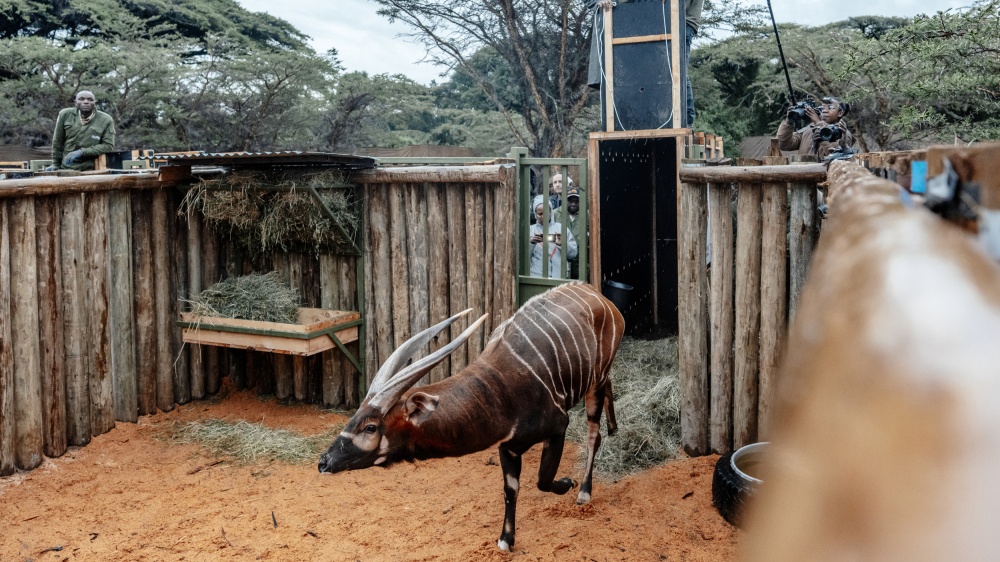
Release of the bongos in Kenya following their arduous transport from Europe. Photo: Petr Topič, Safari Park Dvůr Králové
Lenka Poliaková, Director of Prague Zoo, said: “The project to return bongos to the land of their ancestors is a perfect demonstration that nature conservation knows no borders, whether national or continental. Without the cooperation of many institutions, this transport would not have been possible. I would also like to highlight the crucial role zoos play as reservoirs of genetically valuable populations. When a situation becomes critical, as it did for bongos in Kenya, zoos can—and, in my opinion, must—serve as modern-day Noah’s Arks. In this case, the effort has been a success, and we are proud that our contribution has helped the bongos.”
The last of the four males entered the prepared enclosure at the Mount Kenya Wildlife Conservancy at 7:44 am on Wednesday, 29 April. It was almost exactly 48 hours after loading of the transport crates began in Dvůr Králové. Initial observations indicated that all four bongos were doing well.
Nicol Adamcová, Ambassador of the Czech Republic to Kenya, symbolically handed over the critically endangered animals to the Kenyan government at Nairobi airport, stating: “The repatriation of eastern bongos from EAZA to Kenya took place under the auspices of the President of the Czech Republic, Petr Pavel. Recognition at the highest level not only demonstrates the success of EAZA’s conservation activities, but also confirms that the Czech Republic and other European countries regard nature conservation as one of the fundamental pillars of cooperation with Kenya.”
Rebecca Miano, Kenya’s Minister of Tourism and Wildlife, described the arrival of the four males as a significant step in the broader national programme to restore the eastern bongo (also known as the mountain bongo) population in Kenya. She added: “This moment demonstrates Kenya’s commitment to protecting its natural heritage through science-based and partnership-driven conservation. Each animal strengthens the National Recovery and Action Plan for the Mountain Bongo and further supports our broader strategy to save endangered species. It also confirms Kenya’s leading role in global conservation and sustainable ecosystem management. The breeding and reintroduction programme at MKWC represents a model for future species conservation projects and shows that a coordinated approach delivers measurable results.”
The welcoming ceremony for the eastern bongos was also attended by Jan Stejskal, Director of International Projects at Safari Park Dvůr Králové, who coordinated the bongos’ repatriation to Kenya, and Chester Zoo’s Nick Davis, EEP coordinator for eastern bongos, who said: “This transport is the result of years of planning and cooperation. It demonstrates how EAZA and its member zoos can provide practical support for species recovery through expert population management, international collaboration and shared commitment. It involves carefully planned, population-level management across continents, making the best possible use of genetic diversity where it is most needed.”
The new males from Europe will make a significant contribution to expanding the breeding capacity, strengthening genetic diversity and accelerating the species’ reintroduction to its historical range.
The bongos set off from Dvůr Králové on the morning of Monday, 27 April. Loading began at 8 am and took more than two hours. Lucie Křížová, an ungulate keeper from Prague Zoo, also arrived in Dvůr Králové to accompany the convoy. She had previously been caring for Mau, one of the males selected for transport, and was also the first to initiate Prague Zoo’s activities supporting eastern bongo conservation in Africa.
The aircraft carrying the precious animals landed in Nairobi on 28 April at 8 pm, following a direct flight from Amsterdam lasting approximately eight hours. It also transported more than half a tonne of feed and nutritional supplements to help the bongos acclimatise.
Immediately after landing in Nairobi, a convoy of lorries carrying the four transport crates set off for the Mount Kenya Wildlife Conservancy. There, the team had prepared the best possible conditions to allow the bongos to adapt gradually to their new environment. At MKWC, each animal will undergo a period of acclimatisation and close monitoring before being gradually integrated into the breeding programme. The males will enhance genetic diversity and reproductive potential, helping to produce individuals suitable for future release into the wild.
As Přemysl Rabas, Director of Safari Park Dvůr Králové, explained: “These males will introduce new genetic lineages into the Mount Kenya Wildlife Conservancy’s eastern bongo conservation programme. The individuals were selected on the recommendation of the EEP coordinator from Chester Zoo. The key criterion was genetic compatibility with the animals in Kenya. This is an exceptionally demanding project that demonstrates the high level of expertise at Safari Park and partner zoos. It also reminds us that international cooperation is essential in protecting endangered species. I would like to express my sincere thanks to everyone who contributed in any way whatsoever to the success of the mountain bongo repatriation.”
The bongos had been preparing for the demanding transport since the end of February at a specialised quarantine facility at Safari Park Dvůr Králové. Males from zoos in Givskud, Bojnice, Prague, Berlin and Frankfurt were gradually transported there.
At Safari Park Dvůr Králové, the animals underwent all necessary examinations and transport training. For two weeks, they were cared for by two breeders from MKWC, Erick Kibet Ngen and Christine Gatoni Gichohi. MKWC Director Robert Aruho also visited to assess the animals’ condition. Everyone agreed the males were in excellent condition and fit for transport. The final four individuals were selected solely on the basis of their genetic profiles.
Erustus Kanga, Director General of the Kenya Wildlife Service, concluded: “The return of these four individuals strengthens Kenya’s conservation efforts and our capacity to restore viable eastern bongo populations that are genetically diverse and ecologically resilient. Our goal is not merely to increase numbers, but to restore functional populations capable of thriving independently in protected habitats across the country. This can only be achieved through long-term, science-based investments in species and habitat conservation, guided by a clear vision.”
Andrea Vytlačilová, a world-renowned fashion designer and a native of Mžany in East Bohemia, created the visual identity for the bongo’s regurn to Kenya.
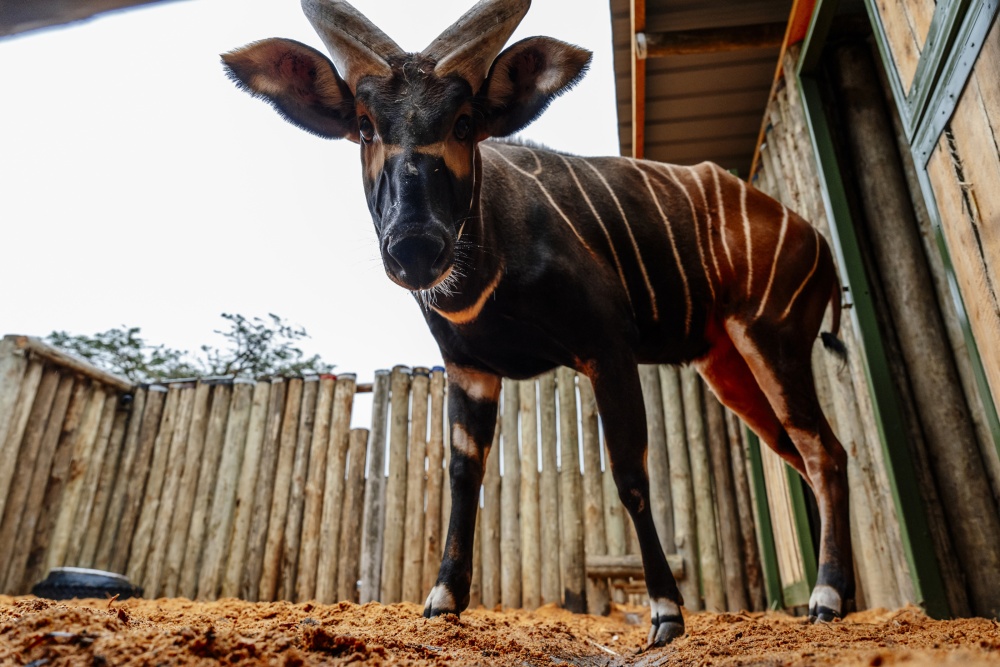
Mau, a male from Prague Zoo, in his new home in Kenya. Photo: Petr Topič, Safari Park Dvůr Králové
Additional information
The eastern bongo
The eastern bongo (also known as the mountain bongo) is the world's largest forest antelope and is endemic to Kenya. Its range is limited to a few isolated Afro-montane forests in central Kenya. Its population has declined dramatically since the 1950s due to intensive poaching (both for bushmeat and for the trade in live animals), disease (especially a rinderpest epidemic in the 1980s), and habitat degradation and loss. The eastern bongo is listed as Critically Endangered on the IUCN Red List. The latest census by the Kenyan government suggests that fewer than 40 individuals remain in the wild.
The first pair, a male Wajir and a female Kindu, arrived at Prague Zoo in 1988. At the time, bongos were considered dangerous and unpredictable. However, a husbandry approach that encouraged their natural curiosity soon revealed them to be highly intelligent antelopes capable of forming strong bonds with their keepers.
Mount Kenya Wildlife Conservancy (MKWC)
The Mount Kenya Wildlife Conservancy (MKWC) is a non-profit organisation focusing, among other activities, on breeding eastern bongos and returning them to the wild. The bongo reintroduction programme began in 2004 with 18 bongos already present in the reserve and was strengthened the same year by the arrival of a further 18 animals from zoos in the United States. Since then, the population has adapted to the Mount Kenya environment and begun to reproduce.
To accelerate their return to the wild, MKWC established the first sanctuary for eastern bongos in 2022. The Mawingu Sanctuary is located within the Mount Kenya Forest Reserve, a former natural range of the species, and is directly connected to Mount Kenya National Park. Thanks to its establishment, the MKWC and Kenya Wildlife Service (KWS) can readily connect bongo breeding with their return to the wild. The population is currently at over 100 bongos, more than 20 of which have already been released into the sanctuary.
Menu
Social networks